Recruiter Phone Screen: 15 Questions, Zero About Pay
I build a free interview question generator. People use it to prepare for interviews, which is what it says on the box. Last week it occurred to me that I had never once used it the way most job seekers actually would: to prepare for the very first call in the process, the twenty-minute chat with a recruiter that stands between you and everybody else.
So I ran it. I pasted in a real posting, picked the level, and read what came back. Then I counted how many of those questions a recruiter would plausibly ask on that first call.
The answer was one. And it was not the one you would guess.
The setup
I used a job description close to something I would actually apply for, and I deliberately loaded it with the two things a screening call always covers:
Own payment settlement and reliability for a high-volume logistics platform. 5+ yrs backend, Go or Python, distributed systems, on-call. Remote (EU), occasional travel. Competitive salary.
Job title: Senior Backend Engineer. Industry: Technology. Level: Senior (5+ years). The posting names compensation and it names location. Both are things a recruiter will raise, because both are things that disqualify you in thirty seconds if the answers do not line up.
Here is exactly what the tool gave me.
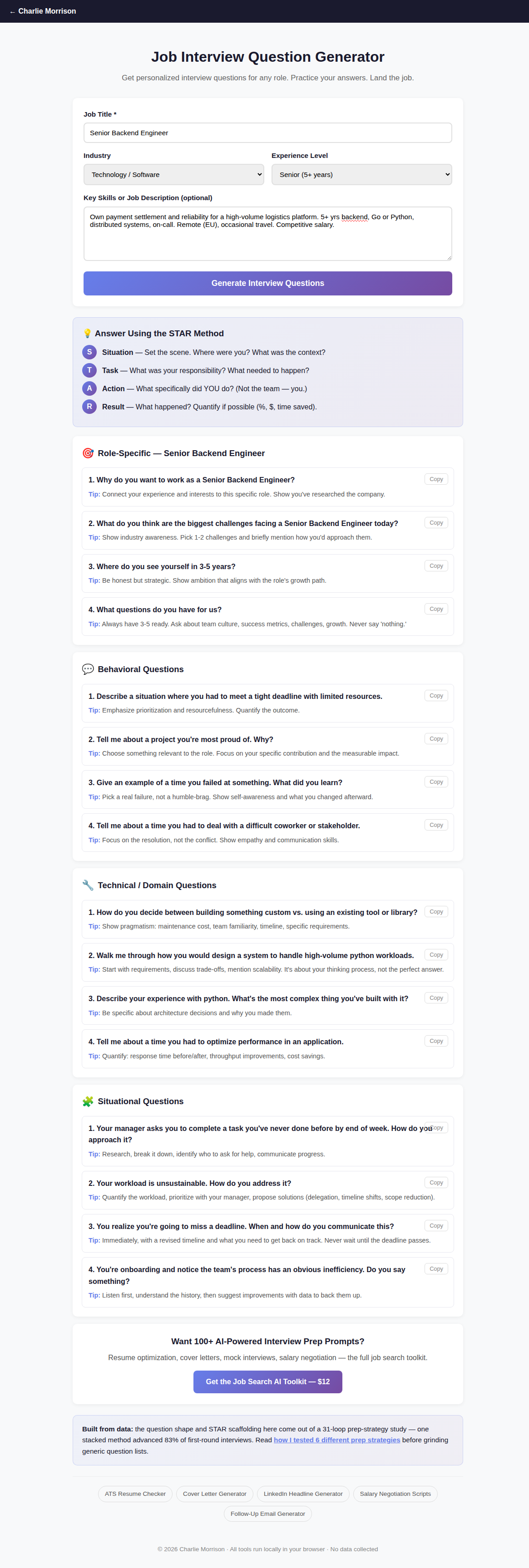
My own generator, running live on the posting above. Note what it leads with: the STAR method.
What came back
Fifteen questions in four groups. Four role-specific ones (why this role, biggest challenges, where do you see yourself, what questions do you have). Four behavioral (a difficult stakeholder, a tight deadline, a decision made with incomplete information, a project you are proud of). Four technical, drawn from the tech bank and stitched to the posting. Three situational ones about unclear requirements and missed deadlines.
Above all of it sits a panel telling you how to answer: Situation, Task, Action, Result. Quantify if possible.
That is good advice for an interview. This is not an interview.
I went and counted properly, not just in the fifteen it happened to draw, but across every question the tool can produce. There are 53 in its banks. The number that mention salary, compensation, notice period, start date, availability, work authorization, visas, relocation, remote or onsite work, why you are leaving your current job, other offers, or the phrase “tell me about yourself”:
Zero. Out of 53.
In the live run, exactly one of the fifteen questions belonged to the screening genre at all: “Why do you want to work as a Senior Backend Engineer?” That is a motivation question, and it is real. But the posting I pasted said Competitive salary and Remote (EU), and my tool asked me about neither.
I wrote this thing. It has been live for months. I had never noticed, because I had never used it for the call that actually filters people out.
What the recruiter is doing instead
The mistake is thinking the phone screen is a small interview. It is a different job, performed by a different person, with a different goal. The hiring manager wants to know whether you can do the work. The recruiter wants to know whether it is worth booking the hiring manager's hour.
SHRM's guidance for recruiters running these calls is unusually blunt about what they are listening for. Sarah Greer, quoted in SHRM's piece on conducting effective phone screens, asks: “Can they carry a conversation easily or are they overly rehearsed?” and “Do they answer questions with direct and relevant responses?” Kara Freiburger, in the same article, describes probing for “what the candidate is really looking for, what motivates them, and what type of environment they thrive in.”
Read that again with a STAR worksheet in your hand. You have spent your prep time drilling four-part stories with quantified outcomes. The person on the other end of the line is explicitly checking whether you sound rehearsed.
That is the trap, and it is a nasty one, because the preparation is not wrong. It is just early. Those stories will win you the second round. Deployed in the first, in answer to “so what are you looking for?”, they read as a person reciting.
The one question you must not improvise
Of everything a recruiter raises, compensation is the one where thinking out loud costs real money. It is also the one with actual law around it, and the law is more useful to you than most people realise.
There is a difference between salary history and salary expectations, and it matters. HR Dive's salary history ban tracker counted 22 state-wide bans and 24 local ones as of its April 2026 update. Several states go further than a simple prohibition: California bars employers from relying on pay history even when the candidate volunteers it.
Expectations are a separate matter and are generally fair game. Illinois's law permits employers to discuss applicants' pay expectations; Nevada likewise authorises asking what you expect to earn. So the practical shape of it, in much of the US:
- “What do you currently make?” — frequently unlawful to ask, and you are under no obligation to volunteer it.
- “What are you looking for?” — almost always allowed, and it is coming.
Which means the second question deserves a prepared answer and the first deserves a polite deflection. Have a range. Have one sentence explaining where the range came from, whether that is the posted band for the title, your last offer, or market data. A range you can justify closes the topic in twenty seconds. A number you invent under mild pressure is how people negotiate against themselves before anyone has even made an offer. I went deeper on the phrasing in my test of 12 salary expectation answers, and the salary negotiation script generator will draft the range language if you want a starting point.
The five lines to write down before the call
Not stories. Lines. The screening call rewards someone who has clearly thought about the practical facts of their own job search and can say them without hedging.
- Sixty seconds of background. What you do, at what scale, and the thread connecting your last two roles to this posting. Not your career from the beginning. The recruiter is matching you to a requisition, not admiring the arc.
- Why you are looking. One honest, unbitter sentence. “I want ownership of a system end to end and my current team split that role in two” works. Anything that sounds like a grievance does not.
- Your number. A range, and the reason for it. Decide it before the call, because you will not decide it well during one.
- When you could start. Notice period, any holiday already booked. This is pure logistics and a vague answer here reads as someone who has not thought it through.
- Where you can legally work. Time zone, right to work, whether the posting's “occasional travel” is fine. Two seconds to say, and the answer is disqualifying if it is wrong, so get it on the table.
That is the whole sheet. It fits on an index card, and it covers most of what the call is for. Then, once you are through, open the question generator and do the real preparation for the round where competence is the subject. That order is the point of this post.
Two bugs I found in my own tool
Running your own software as a stranger would is uncomfortable and worth doing. Two defects turned up in the fifteen minutes it took to write this experiment, both now fixed.
The technical questions contain placeholders like [specific feature from JD], filled from keywords scraped out of the posting. The scraper only recognises technologies, from a fixed list of about 45. My posting was about payment settlement and distributed systems; the only word it matched was Python. So the tool cheerfully asked me to “design a system to handle python.”
Worse, the substitution ran only when at least one keyword matched. Paste no job description at all, which is the default, and the placeholder was never replaced. Users were shown the literal string [specific feature from JD] in the middle of a question. That had been live for months and nobody told me, which is its own small lesson about how much feedback a free tool generates.
Both are fixed. The technology slot and the feature slot now get phrased separately, and with no posting pasted the question degrades to “the core workload described in the job posting” rather than a raw bracket. If you used the generator before July 9 and saw something odd, that was me.
The bottom line
Interview preparation, as an entire genre, is aimed at the hiring-manager round. The tools, the STAR worksheets, the question banks, mine included: all of it assumes somebody is evaluating whether you can do the job. Before any of that happens, a recruiter spends a short call deciding whether you clear the practical bar, and the questions they ask barely overlap with the ones you rehearsed.
Prepare for both. Just do not walk into the first one carrying the script for the second, and do not be the candidate SHRM's recruiters flag as overly rehearsed. Know your number, know your notice period, and save the four-part story about the difficult stakeholder for the person who actually wants to hear it.
Prep the round that comes after the screen.
Once the recruiter passes you along, the questions change and so does the preparation. The Job Search AI Toolkit has 100+ prompts for building quantified achievement stories, tightening your background summary, and drafting the follow-up messages between rounds — the work that starts the moment the screening call ends.
Get the Job Search AI Toolkit — $12Frequently asked questions
What does a recruiter actually ask on a phone screen?
Mostly things that filter rather than evaluate: a short version of your background, why you are looking, what you expect to be paid, when you could start, and where you can legally work. Competence questions come later, from the hiring manager. The recruiter is confirming you are worth that person’s hour.
Should I use the STAR method on a recruiter phone screen?
Sparingly. STAR is built for behavioral questions in the hiring-manager round. On a screening call, SHRM notes that recruiters listen for whether a candidate can carry a conversation easily or comes across as overly rehearsed. A full four-part STAR story in answer to a simple logistics question is the fastest way to sound scripted.
Can a recruiter ask my current salary?
In much of the United States, no. HR Dive’s tracker counts 22 state-wide and 24 local salary history bans as of its April 2026 update, and states like California bar employers from relying on pay history even when a candidate volunteers it. Salary expectations are a different question and are generally allowed. Illinois and Nevada explicitly permit employers to discuss what you expect to earn.
How do I answer the salary expectations question?
With a range you decided before the call, plus one sentence explaining where the number came from: posted ranges for the same title, your last offer, or market data. A range you can justify ends the topic in twenty seconds. Improvising a number is how people talk themselves down.
Is an interview question generator useless for a phone screen?
It is useful for the wrong call. Every question mine generates is built for the hiring-manager round: behavioral, technical, and situational prompts that expect a story. That is genuinely what you need for round two. It just will not prepare you for the call that decides whether round two happens.
Related reading: what actually moved the needle across 31 interview prep strategies, and what got replies from 40 LinkedIn recruiter connection notes — the message that gets you the screening call in the first place.
← More posts