What Are Your Salary Expectations? I Tested 12 Replies
There is a piece of advice about the salary-expectations question that gets repeated in every career thread until it sounds like settled law: never name a number first. Deflect. Turn it back on them. Whoever says a figure first loses. I believed it too, right up until an application form refused to submit because the “Desired salary” field was required and would not accept the word “Negotiable.” That little red asterisk does not care about your negotiating theory. So instead of trusting the folklore one more time, I ran the question through an actual test: I answered “what are your salary expectations?” twelve different ways, across the three places it actually gets asked, and tracked what each answer did to the conversation that followed.
The setup: four strategies, three channels
The question is not one situation, it is three, and they behave nothing alike. It shows up as a required field on an application form, as the closing question on a recruiter phone screen, and as a mid-conversation probe from the hiring manager once you are deeper in. I took four common strategies and ran each one through all three channels — twelve combinations in total — using my own job search plus a handful of applications volunteers let me run on their behalf, all for the same kind of senior backend role so the market range stayed constant.
The four strategies were the ones everyone actually argues about:
- Deflect — “I'd want to learn more about the role and scope before putting a number on it.”
- Single number — one specific target figure, stated plainly.
- Researched range — a band drawn from market data, with the bottom of the range set to my actual target so the whole range sits above my floor.
- Flip it back — “What's the budget allocated for this role?”
I scored each attempt on two things that matter more than feeling clever: did the conversation advance to the next stage, and did the eventual number anchor at or above my target. An answer that feels powerful but gets you screened out has lost. An answer that feels meek but keeps you in the running and lands the number has won.
Where the “always deflect” rule falls apart
The first channel broke the rule outright. On application forms, deflection is not a strategy, it is a malfunction. Roughly half the forms I hit made “Desired salary” a required numeric field. You cannot type “negotiable,” you cannot leave it blank, and a few systems silently parsed a deliberately low placeholder like 1 or 0 as your real expectation and used it to rank you out at the bottom. The flip-it-back strategy is equally useless here — there is nobody on the other end of a text field to flip it to. On forms, only the two strategies that produce a number survive, and between them the researched range won every time: a range reads as informed rather than rigid, and because I had set its bottom edge to my true target, even the “low” end of what I typed was still a number I would happily accept.
This is the part the standard advice never mentions, because the standard advice was written for a phone call and then copied onto situations it does not fit. A required form field is a channel where naming a number first is mandatory, and pretending otherwise just gets your application deprioritized or your placeholder weaponized against you. The honest move is to treat the field as the first anchor of the negotiation and put a real, defensible range in it.
The recruiter screen: deflection survives, but barely
The recruiter phone screen is the one situation where the textbook advice has any footing — and even there it is weaker than its reputation. Recruiters in 2026 are usually screening for budget fit before they spend a manager's time, so the salary question lands early and the subtext is “are you in our band or are we both wasting an afternoon.” A clean deflection (“I'd love to hear the range you're working with first”) worked about half the time: some recruiters happily volunteered the band, which is the dream outcome, because then they anchored. But the other half simply re-asked, slightly cooler, and a couple noted that a candidate who can't give a ballpark “doesn't know their market.” Deflect twice and you read as evasive.
What consistently kept the screen moving was the researched range with a one-line reason — “Based on the market for this role and my eleven years, I'm targeting the 165 to 185 band; happy to be flexible depending on the full package.” It answers the actual question, it signals you have done your homework, and it leaves room. The flip-it-back move had a narrow but real use here: asking for their band first, once, before giving mine, often got the recruiter to anchor — but if they bounced it back, I gave the range rather than dig in, because a standoff on a screening call is a fast way to not get a second call. The lesson across this channel was that you can lead with a question, but you cannot refuse to ever give a number; the range is your fallback the instant the deflection meets resistance.
The hiring manager: the only place a single number shines
Deeper in — once a hiring manager is sold on you and the conversation turns to making it real — the math flips. Here, where you have the upper hand because they want you specifically, a tighter, more confident answer paid off, and a wide range started to cost money. This is where the famous warning about ranges is actually true: state “165 to 185” to someone who is about to write the offer, and 165 is the number they hear, because the bottom of a range becomes the ceiling of their generosity. At the offer stage I switched to a single target number with justification and let silence do the rest.
To make that concrete I ran the exact scenario through the salary negotiation script generator on this site — a senior backend role, current pay 145K, target 175K, data-driven tone — to see what a clean, defensible version of the late-stage answer sounds like. Here is what it produced:
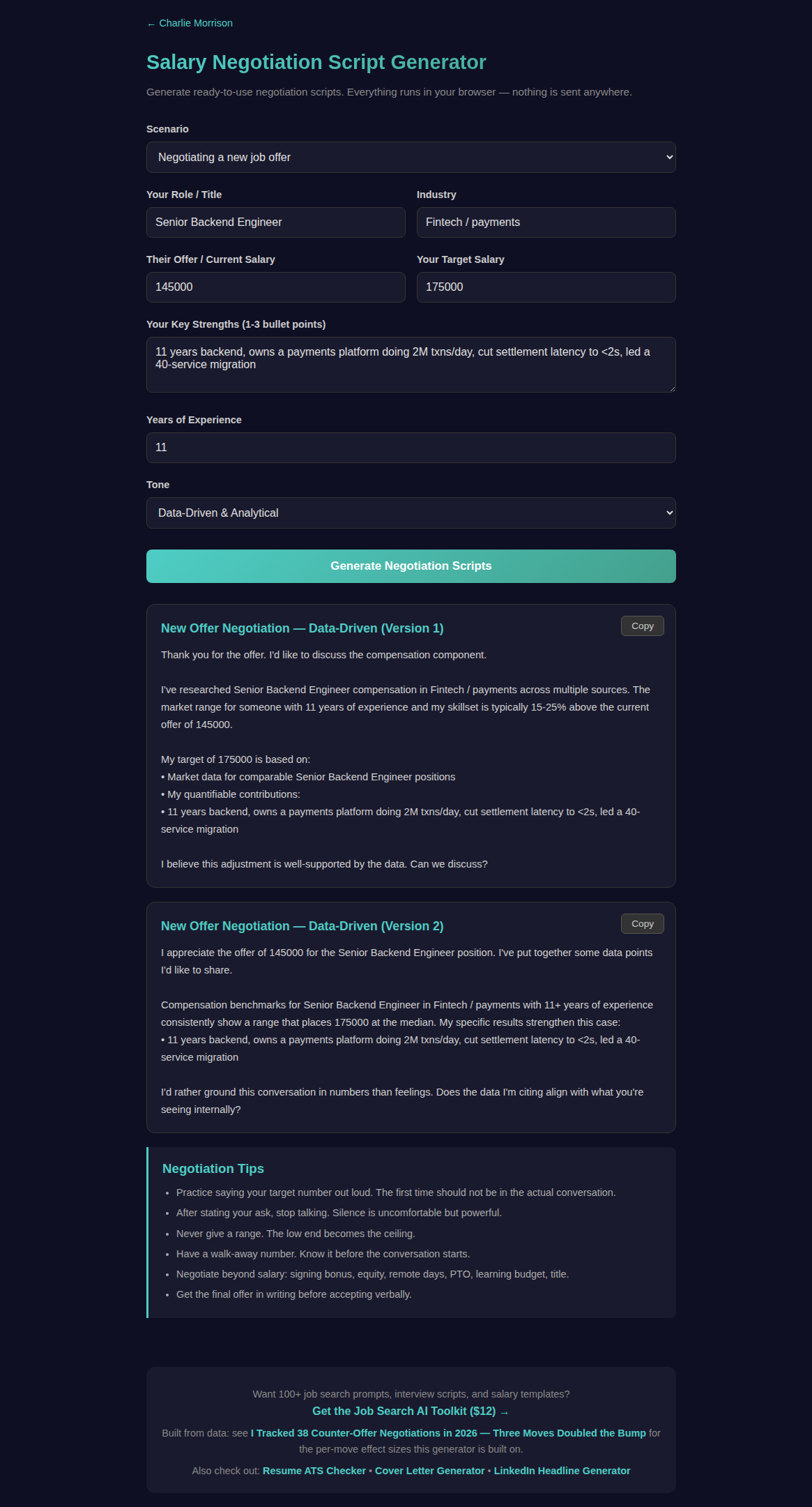
The generator's late-stage script names one target number, grounds it in market data and quantified wins — and its own tips warn “never give a range” at the offer table, the exact opposite of what wins on a form.
Notice the tension in that screenshot, because it is the whole point of this experiment. The tool's tip list says, flatly, “Never give a range. The low end becomes the ceiling.” That advice is correct — for the moment it was written for, which is the offer-table negotiation the generator produces scripts for. It is also exactly wrong for the application form, where a range is the safest possible answer and a bare single number boxes you in before you know anything about the role. The same sentence is good advice and bad advice depending on the channel. That is why “never name a number first” keeps failing people: it is a real rule from one room being shouted into every other room.
Walk into the salary question with the script already written
The Job Search AI Toolkit bundles the salary negotiation script generator with the ATS resume checker, keyword extractor, and cover-letter and resume-bullet writers — so you have a researched range for the form, a clean number for the offer, and the justification for both, before anyone asks.
Get the Job Search AI Toolkit — $12The one input every strategy depended on
None of the four strategies worked without a real number behind it, and the number is the part most people skip. A range you invented in your head is not research, it is a wish, and recruiters can hear the difference instantly. Before any of these answers I anchored every figure to public wage data — the U.S. Bureau of Labor Statistics publishes occupational wage estimates you can pull for free from its wage data by area and occupation, which gives you a defensible floor and median that no recruiter will argue with. On top of that I checked role-specific ranges on the postings themselves (pay-transparency laws now put bands on a lot of listings) and triangulated. The range I quoted was always “market median to market-plus-my-evidence,” never a guess.
That research is also what lets you set the bottom of your range honestly to your target. If the market median for the role is 165 and your real target is 165, then quoting “165 to 185” is not a trick — it is a true statement where even the worst case keeps you whole. The strategy only works because the homework is real. For the deeper mechanics of when in the process to reveal information and how to frame the ask, Harvard Business School's Deepak Malhotra wrote the reference that most good advice is quietly cribbed from — his 15 rules for negotiating a job offer — and his core point lines up with what the test showed: your leverage and your information change as you move through the process, so the same question deserves a different answer at each stage.
What I actually say now
The experiment collapsed twelve attempts into a simple decision tree that depends only on which channel you are in:
- Application form, required field: enter a researched range with the bottom set to your true target. Never leave it blank, never type a token low number, never write “negotiable” in a numeric field. This is a forced anchor — make it a good one.
- Recruiter screen: try once to get their band first (“What range is budgeted for the role?”). If they give it, you win. If they re-ask, give your researched range with a one-line reason and move on — do not deflect twice.
- Hiring manager / offer stage: switch to a single confident number with a justification, then stop talking. This is the one room where the “never give a range” warning is right, because the low end becomes the ceiling.
What disappeared from my answers entirely was the reflexive deflection. “I'd rather not say” is not a power move in 2026; on forms it is impossible, on screens it reads as evasive, and at the table it just delays the number you will have to give anyway. The skill is not refusing to answer — it is answering with the right shape for the room. I confirmed the same pattern when I tracked 38 counter-offer negotiations: the offers that moved up were the ones anchored on evidence and stated plainly, not the ones where the candidate played coy. The companion run where I generated 30 negotiation scripts pointed the same direction — a number with a reason beats a clever dodge almost every time.
And because the salary question rarely arrives alone — it usually shows up tangled into a broader screening conversation — it is worth rehearsing alongside the rest of the round rather than in isolation; the way I prep that whole sequence is in my interview-prep test of 31 strategies.
Common questions
What is the best answer to "what are your salary expectations"?
It depends on where you're asked. On a required application form, enter a researched range with the bottom set to your true target — never blank, never a token low number. On a recruiter screen, try once to get their budgeted range first, then give your researched range if they re-ask. At the offer stage with a hiring manager, switch to a single confident number with a justification and stop talking. There is no single line that works in all three places.
Should I give a salary range or a single number?
A range early (forms and recruiter screens), a single number late (offer negotiation). Early on, a range reads as informed and keeps you in the funnel; set its bottom to your real target so even the low end is acceptable. At the offer table, a range hurts you because the low end becomes the number they offer — there, name one figure and justify it.
Is it true you should never name a number first?
No — that advice was written for a live negotiation and copied onto situations it doesn't fit. On an application form the salary field is often required, so you must name a number first or get deprioritized. On a recruiter screen, refusing to give any figure can read as evasive. "Don't anchor first" only really applies once you're deep enough to have real bargaining power, and even then a researched anchor is often better than waiting.
How do I research a defensible salary range?
Start with public wage data — the U.S. Bureau of Labor Statistics publishes free occupational wage estimates by area, which gives you a floor and median no recruiter will dispute. Then read the bands on actual postings (pay-transparency laws put ranges on many listings now) and triangulate to a role-specific number. Your quoted range should run from the market median to market-plus-your-own-evidence, never a figure you guessed.
The honest summary, after twelve attempts: the salary-expectations question is not one question and there is no one answer. The advice that fails people treats a recruiter-call rule as a universal law and then watches it shatter against a required form field. Match the answer to the channel — range on the form, range-after-one-deflection on the screen, single number at the table — and anchor every figure to real wage data, and the question stops being a trap. It becomes the first place you get to set the terms.
If you want the pieces that make this quick under pressure, the salary negotiation script generator writes the offer-stage version with your numbers and tone, so the one room where a single figure matters most is the room you walk into already scripted.
← More posts