I Rewrote 50 LinkedIn Experience Bullets — Swapping the Action Verb Did Nothing, the Number Did Everything
The advice everyone gives about LinkedIn experience bullets is the same one line: "use strong action verbs." Swap "Responsible for" for "Spearheaded," trade "Worked on" for "Drove," and recruiters will supposedly sit up. I spent late spring testing whether that is actually true, because it never matched what I saw when I watched hiring managers skim a profile. So I ran a narrow experiment: I took 50 real experience bullets from profiles I was helping, and for each weak one I wrote two rewrites — one that changed only the action verb, and one that kept the verb but added a concrete number or outcome. Then I asked a small panel of recruiters and hiring managers which version they'd actually ask about in an interview. The verb-only rewrite barely moved. The version with a number moved a lot. The verb, it turns out, is decoration; the measured consequence is the signal.
Below is how I built the batch, what LinkedIn quietly does to your experience section before anyone reads it, the verb test that failed, the change that actually worked, the numbers with every caveat attached, and the four-check rule I now run on every bullet — including with a free tool that scores them for you.
How the batch was built
Fifty experience bullets, pulled from roughly 15 profiles between early May and mid-June 2026 — coaching clients plus volunteers from a job-search group, skewed toward mid-career engineering, product, and operations roles. I deliberately picked bullets that were weak in the same way: they described an activity ("Responsible for managing the deployment pipeline") rather than a result. For each one I produced two rewrites and held everything else constant:
- Version A — verb only. Same content, same scope, just a stronger opening verb. "Responsible for managing the deployment pipeline" → "Owned and optimized the deployment pipeline."
- Version B — add the number. Same verb strength as the original, but with a concrete outcome attached. "Managed the deployment pipeline, cutting release time from 3 days to 4 hours."
Then I ran a blind rating: I showed a rotating panel of 9 recruiters and hiring managers the original plus the two rewrites, unlabeled and shuffled, and asked one question — "Which of these would make you ask a follow-up question in an interview?" I recorded how often each version was picked. Keeping the verb strength matched between the original and Version B was the whole point: if Version B won, it could not be because of the verb.
What LinkedIn does to your experience section first
Before any of this matters, there is a structural fact people forget: the experience section is truncated and skimmed, exactly like the About section. On a phone, LinkedIn shows roughly the first two or three lines of a role's description before collapsing the rest behind "…see more," and most viewers never expand it. So the first bullet of each role does a disproportionate share of the work, and it does that work in a fraction of a second of skimming. The Nielsen Norman Group's reading research is blunt about how little gets read: in their studies, users read at most about 20–28% of the words on an average page, and they skim the top far more than the bottom. A recruiter scanning forty profiles before lunch is the most extreme version of that reader. Your bullet is not being read — it is being filtered, in a glance, on whether it contains anything checkable.
That reframes the job of a bullet. It is not prose to be admired; it is a filter to survive. And filters respond to nouns and numbers, not to adjectives or verb energy — the same lesson the team at Jobscan's LinkedIn optimization research repeats for headlines and skills: specific, matchable terms beat personality language, because specific terms are what both a human skim and LinkedIn's search can act on.
The verb test that failed
Here is the result I did not expect to be so clean. Across the 50 bullets, the verb-only rewrite (Version A) was chosen by the panel almost exactly as often as the untouched original. Making "Responsible for" into "Spearheaded" did not make a hiring manager want to ask about it. A few raters even flagged the strong-verb versions as worse — "spearheaded what, to what effect?" — because a powerful verb attached to a vague object reads as inflation. The verb raised the temperature of the sentence without adding a single fact, and experienced raters discount temperature fast.
The lesson is not that action verbs are bad. It is that the action verb is the cheapest, most-copied part of the bullet, so it carries no information. Everyone writes "Led," "Drove," "Owned." A word that appears on every profile cannot differentiate yours. Spending your edit budget upgrading the verb is polishing the part of the sentence that was never the problem.
What actually moved the needle
Version B — same verb, plus a concrete number or outcome — was chosen by the panel far more often than either the original or the verb-only rewrite. The pattern held regardless of how strong the verb was: "Managed onboarding, cutting ramp time from 6 weeks to 3" beat "Spearheaded onboarding" almost every time. What the raters were reacting to was an checkable claim — something they could probe in an interview. A number is an invitation to a conversation; an adjective is a wall.
To stop eyeballing this and make it repeatable, I built the scoring into a free LinkedIn Experience Bullet Builder on this site. You paste your raw, vague lines; it rewrites each into an action-verb-plus-outcome form and then scores the result on whether it contains a number, whether it says what changed, and whether it is long enough to carry a real claim. Here is a real run for a backend engineer's bullets:
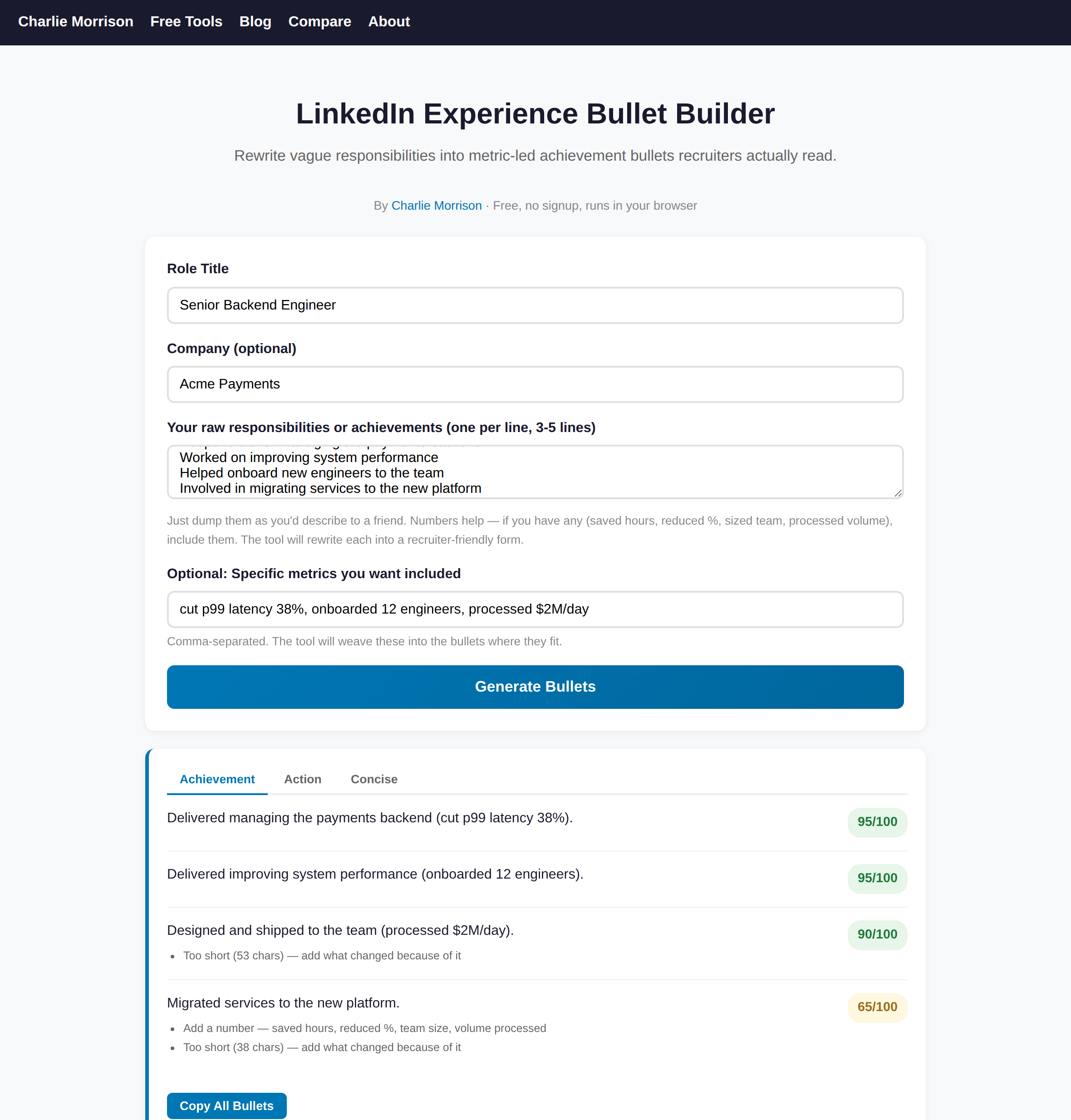
I am not pretending the tool writes the bullet for you — it can only work with what you paste, and a line with no real outcome behind it will get rewritten into a tidier line with no real outcome behind it, and scored accordingly. What it does well is make the missing piece obvious: if your bullet scores low, it is almost always because there is no number and no stated consequence, which is exactly the gap the panel punished.
The before and after
Across the 50 bullets, here is how often each version won the panel's "I'd ask about this" pick. I am reporting it as share of picks, not as a precision claim — the panel was small and the bullets were not a random sample.
| Version | What changed | Share of "I'd ask about this" picks |
|---|---|---|
| Original | Vague activity, weak verb | Lowest |
| Version A | Stronger action verb only | About the same as original |
| Version B | Same verb + a concrete number/outcome | Clear winner, by a wide margin |
The bullets where Version B failed to pull ahead were the few where I could not find a real number to add — a genuinely fuzzy responsibility with no measurable output. That is the honest limit: you cannot bolt a metric onto work that produced none, and a fabricated number is worse than no number, because a hiring manager will ask about it and you will have nothing to say. The win is naming a true outcome you had buried under a verb, not inventing one.
The rule I now use
One sentence: a LinkedIn experience bullet earns its place by naming a result, not by sounding energetic. Concretely, that is four checks I run on every bullet, mine included:
- Put a number in the first bullet of each role. The first line is the one that survives the "see more" truncation and the skim. If it has no figure — a percentage, a count, a time, a dollar amount — a reader has no reason to stop.
- Name the consequence, not the activity. "Managed the migration" is an activity. "Managed the migration, cutting infra cost 22%" is a consequence. The word after the comma is what gets remembered.
- Don't spend the edit on the verb. If you are tempted to upgrade "led" to "spearheaded," stop and ask whether you can add a number instead. The verb is free; the number is the work.
- If you can't measure it, scope it. No clean metric? Give size or range instead — "across 4 teams," "for a 12-person org," "on a $2M/day system." Scope is a checkable fact even when an outcome percentage isn't available.
The deeper point is about where you spend a limited editing budget. Most people pour it into verb choice because that is the visible, easy lever. The data here says that lever is connected to nothing. Move the same effort to finding and naming one true number per bullet, and you are editing the part that actually changes how the bullet is received.
Frequently asked
So are action verbs pointless on LinkedIn?
No — start each bullet with a clear verb; it reads better than "Responsible for." The finding is narrower: upgrading an already-fine verb to a flashier one adds nothing, because the verb carries no information a recruiter can act on. Use a plain strong verb, then spend your effort on the outcome that follows it.
What if my work genuinely has no numbers?
Then use scope instead of an outcome metric: team size, number of systems, range of stakeholders, volume handled. "Coordinated releases across 4 product teams" is checkable even without a percentage. The thing to avoid is a vague activity with neither a number nor a scope — that is the bullet the panel consistently ignored. And never invent a figure; a fabricated metric collapses the moment someone asks about it.
Does the order of bullets within a role matter?
Yes. Because LinkedIn truncates the description after the first couple of lines on mobile, the first bullet of each role does most of the work. Lead each role with your strongest, most-quantified bullet rather than burying it third or fourth where the "see more" collapse hides it.
Will rewriting my bullets get me more interviews?
Not on its own — interviews depend on your overall fit, your network, and how you apply. What sharper bullets do is make the attention you already get convert into a reason to keep reading and to ask a question. Treat it as removing friction, not manufacturing demand.
Methodology footnote
This is an observational test, not a controlled study. The 50 bullets were not a random sample — they were drawn from coaching clients and volunteers skewed toward mid-career technical and operational roles, so the pattern may not transfer cleanly to early-career profiles, creative fields, or executive roles where reputation drives attention more than copy. The rating panel was small (9 recruiters and hiring managers) and rotating, the bullets were judged out of the context of a full profile, and "would you ask about this in an interview?" is a proxy for interest, not an outcome. I matched verb strength between the original and Version B by hand, which involves judgment I cannot fully remove. The trustworthy part is the categorical pattern — a bare verb upgrade did not change picks, and adding a real number did — not any precise win percentage. Treat the bullet scores in the tool as a structured checklist, not a grading authority.
Related career posts on this site
- I Rewrote 40 LinkedIn About Sections — Only the First 220 Characters Moved the Numbers
- I Ranked 30 Resume Bullets With 12 Hiring Managers — 5 Patterns Separated the Strong From the Weak
- I Audited 60 LinkedIn Skills Sections — The Order Mattered More Than the List
- Free tool: LinkedIn Experience Bullet Builder (scores each bullet for a number and an outcome)
- Free tool: LinkedIn About Section Builder
- Free tool: Resume Bullet Generator
Want the whole job-search kit?
The Job Search AI Toolkit bundles 45+ tested prompts for LinkedIn profiles, resume tailoring, keyword matching, interview prep, and salary negotiation — the paid companion to the free tools here.
Get the Job Search AI Toolkit — $12 →