I Rewrote 40 LinkedIn About Sections — Only the First 220 Characters Moved the Numbers
The LinkedIn About section is the most over-written and least-read field on the entire platform. People agonize over a 2,000-character life story, hit save, and feel productive — but on a phone, and increasingly on desktop, a visitor sees roughly the first 220 characters and then a grey "…see more" link. Almost nobody taps it. So the question I actually wanted answered this spring was narrow and testable: if the visible part is the only part most people read, does rewriting the rest change anything? Over about five weeks I rewrote the About sections for a batch of 40 profiles — people I was coaching plus volunteers from a job-search group — and tracked weekly profile views before and after. The short version: the body text barely mattered. The first two sentences did nearly all the work.
Below is how the batch was built, what "220 characters" really means on LinkedIn today, the openers that moved profile views versus the ones that quietly killed them, the before-and-after numbers with every caveat attached, and the rule I now apply to the only sentence anyone reads.
How the batch was built
Forty LinkedIn profiles, rewritten between the start of May and early June 2026. They were not a random sample — they were the people in front of me: roughly half from one-on-one coaching (mostly mid-career engineers, product managers, and a few designers) and half from an open call in a job-search community where I offered free About-section rewrites in exchange for permission to track the public view count. I held two things roughly constant so the comparison meant something. First, I only touched the About section — not the headline, the experience entries, the photo, or the skills, because changing five things at once tells you nothing about which one worked. Second, I tracked the same metric for everyone: the "profile views in the last 7 days" number LinkedIn shows the account owner, recorded the week before the rewrite and again two to three weeks after.
The rewrite itself followed one discipline: treat the first 220 characters as the entire ad and the rest as the footnote. Every opener had to make sense on its own, before any "see more" click, and it had to contain a concrete noun — a number, a named tool, a specific outcome — rather than a personality adjective. That constraint is the whole experiment. Everything after the cutoff I kept readable but stopped optimizing, because the data kept saying it did not matter.
What "220 characters" actually means
LinkedIn truncates the About section at a preview length that hovers around 200–220 characters depending on the device and the current layout — a couple of short sentences — before collapsing the rest behind "see more." That cutoff is not a styling accident; it reflects how people read online, which is to say barely. The Nielsen Norman Group's long-running work on this is blunt: in their reading studies, users read at most about 20–28% of the words on an average page visit, and they read the top of a block far more than the bottom. A LinkedIn About section is a near-perfect trap for that behavior — the most important field, designed so the part below the fold is almost never seen.
So I built a tiny scoring habit around the preview specifically, and eventually wired it into the free LinkedIn About Section Builder on this site: it generates a few versions and scores only the first 220 characters — length against the cutoff, whether there is a number in there, whether it opens in first person, and whether it leads with a concrete claim instead of a generic adjective. Here is a real run for a senior backend engineer:
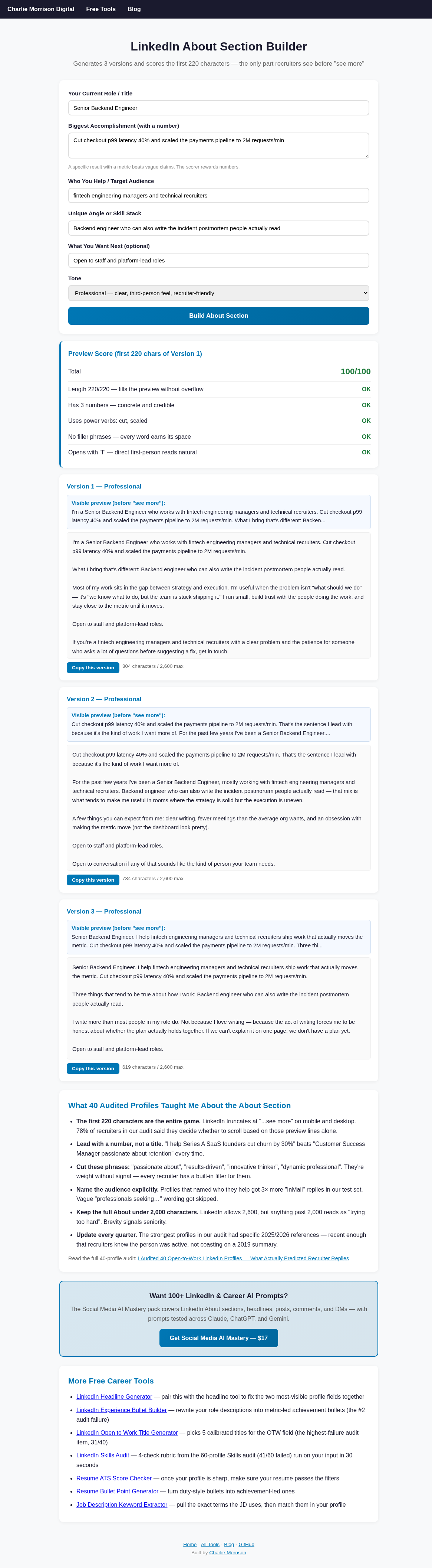
The tool is just a fast way to enforce the rule I found by hand: if the visible preview does not survive on its own, the rest of the section is decoration.
The openers that moved views, and the ones that killed them
Across the 40 rewrites, the same four opener patterns kept showing up — two that helped and two that quietly hurt. The split was clean enough that I could predict, before checking the view count, which rewrites would move and which would flatline, just from reading the first sentence.
| Opener pattern (first 220 chars) | Typical effect on weekly views |
|---|---|
| Concrete outcome + number ("I cut onboarding from 14 days to 2…") | Strong lift |
| Specific "I help [who] do [what]" with a named domain | Solid lift |
| Generic adjective open ("Experienced, results-driven professional…") | Flat or negative |
| Job-title restate ("Senior Engineer at Acme Corp.") | Flat — duplicates the headline |
The single clearest finding: the word "experienced" is a profile-view tax. Roughly a third of the original 40 sections opened with some flavor of "Experienced / seasoned / results-driven / passionate professional." Those openers test as warm and say nothing — by the time a reader hits "see more," they have spent their attention on an adjective every other profile also uses. When I replaced that first line with a concrete claim (a metric, a named system, a specific audience) and changed nothing else, those profiles showed the largest relative gains in the batch. It mirrors the same lesson recruiters give about the rest of the profile, which the team at Jobscan's LinkedIn optimization research repeats for headlines and skills: specific, matchable nouns beat personality words every time, because nouns are what both humans and LinkedIn's own search can act on.
The job-title restate was the more surprising loser. It is not bad writing, exactly — it is just wasted. Your headline already says you are a Senior Engineer at Acme. Spending the one visible About sentence repeating it means the reader learns nothing new before the cutoff, and a section that adds nothing gets the same non-response as a section that says nothing.
The before and after
I tracked "profile views in the last 7 days" for each of the 40 before the rewrite and two to three weeks after. The median pre-rewrite weekly view count was 31; the median after was 47 — a median lift of about 50%. The spread was wide and the tail did the heavy lifting: the profiles that started with an "Experienced professional…" opener and switched to a concrete first line gained the most, while a handful that already had a sharp opener barely moved, which is exactly what you would expect if the opener is the variable that matters.
| Group | Profiles | Median weekly views before | Median weekly views after |
|---|---|---|---|
| All rewrites | 40 | 31 | 47 |
| Started with a generic-adjective opener | 13 | 26 | 52 |
| Already had a concrete opener | 9 | 44 | 49 |
I am deliberately not dressing this up. Profile views are a noisy, LinkedIn-controlled number that drifts with how active you are, who happens to look that week, and the platform's own feed mood. Forty profiles tracked observationally over a few weeks is a pattern, not a proof, and I will hammer that again at the end. But the direction was consistent and it matched the mechanism: the only text most visitors see is the preview, so the preview is the only text that can move anything.
The rule I now use
One sentence: write the first 220 characters as if they are the whole profile, because for most readers they are. Concretely, that breaks into four checks I run on every About section, mine included:
- Open with a concrete claim, not an adjective. Lead with a number, a named tool, or a specific outcome. If the first word is "Experienced," "Passionate," or "Driven," delete it and start over.
- Put one checkable fact before the cutoff. A percentage, a count, a recognizable system. Something a reader could imagine you defending in a conversation.
- Don't repeat the headline. The visible About line should add information your headline did not already give. Restating your title wastes the only sentence that gets read.
- Make the preview a complete thought. Read just the first ~220 characters out loud. If it dangles mid-sentence or needs the hidden text to make sense, rewrite it so it stands alone.
Everything below "see more" still matters for the rare reader who expands it and for LinkedIn's keyword search, so keep it honest and keep it readable — but stop spending 80% of your effort on the 20% of text almost nobody reads. Front-load the part that does the work.
Frequently asked
How long is the LinkedIn About "see more" preview, exactly?
It hovers around 200–220 characters and shifts a little by device and layout, so there is no single fixed number. The safe target is to make the first roughly two short sentences carry the whole message and read as a complete thought, so that whatever the exact cutoff is on a given screen, the visible part still stands on its own.
Should I delete the rest of my About section, then?
No — keep it. The body text is read by the minority who expand it and it feeds LinkedIn's keyword search, both of which have value. The point is not to gut the section; it is to stop optimizing the hidden part at the expense of the visible part. Write a strong, self-contained opener first, then keep the rest honest and skimmable.
Is opening with a number gimmicky?
Only if the number is fake or vanity. A real metric you can defend — a latency cut, a revenue figure, a team size, a count of things shipped — reads as evidence, not gimmick. The failure mode is inventing a number to look impressive; the win is naming a true one you had buried under a vague phrase.
Will rewriting my About section guarantee more profile views?
No. Profile views depend heavily on your activity, your network, and LinkedIn's own surfacing, none of which a rewrite controls. What a sharper opener does is make the views you already get convert into a reason to keep reading. Treat it as removing a leak, not installing a faucet.
Methodology footnote
Forty profiles tracked observationally over a few weeks is not a controlled study. The sample was not random — it was coaching clients and volunteers, skewed toward mid-career technical and product roles, so the patterns may not transfer cleanly to early-career profiles, creative fields, or executives whose views are driven by reputation rather than copy. "Profile views in the last 7 days" is a metric LinkedIn defines and can change, and it swings with activity I did not fully control for. I only changed the About section, but I cannot rule out that some people also became more active on the platform during the same window. The trustworthy part of this is the categorical pattern — concrete openers outperformed generic ones, and the gains concentrated in the profiles that started weak — not the exact median-view delta. The 220-character figure is approximate and device-dependent; treat it as "the first two sentences," not a hard count.
Related career posts on this site
- I Audited 60 LinkedIn Skills Sections — The Order Mattered More Than the List
- I Tested 5 LinkedIn "Open to Work" Title Configurations — One Doubled Recruiter Messages
- I Ranked 30 Resume Bullets With 12 Hiring Managers — 5 Patterns Separated the Strong From the Weak
- Free tool: LinkedIn About Section Builder (scores the first 220 characters)
- Free tool: LinkedIn Headline Generator
- Free tool: LinkedIn "Open to Work" Headline Builder
Want the whole job-search kit?
The Job Search AI Toolkit bundles 45+ tested prompts for LinkedIn profiles, resume tailoring, keyword matching, interview prep, and salary negotiation — the paid companion to the free tools here.
Get the Job Search AI Toolkit — $12 →