I Sent 30 Cover Letters — Personalized vs Template, and the Reply Gap Wasn't What I Expected
There are two pieces of cover-letter advice on the internet and they contradict each other. One camp says nobody reads cover letters, skip them, they're a relic. The other camp says every letter must be painstakingly personalized to the company or you may as well not apply. Both are stated with total confidence, and neither comes with numbers. So this spring I ran the only test I could actually run from my side of the table: I applied to 30 mid-level backend and platform roles, sent a fully personalized cover letter to half and a solid generic template to the other half, and tracked who replied. The answer turned out to sit between the two camps — and the thing that moved the needle wasn't the amount of personalization, it was where it went.
Below is exactly how the batch was built, the reply numbers with every caveat attached, the one variable that separated the letters that got answered from the ones that didn't, and the short checklist I now use before I send anything.
How the batch was built
Over about six weeks I applied to 30 roles that were a genuine fit for my background — no spray-and-pray, no reaching for jobs I had no business applying to, because that would have poisoned the reply rate with noise that had nothing to do with the letter. For each application I flipped between two treatments in roughly alternating order:
- Personalized (15 letters): an opening line that named something concrete and specific about the company — a product, an engineering blog post, a public talk, a problem they'd written about — plus two body sentences that mapped my experience onto the actual requirements in the posting.
- Template (15 letters): a clean, well-written, structurally identical letter with the company name and role swapped in, but a generic opener ("I'm excited to apply for…") and body points that were true but not tailored to that specific posting.
Both versions were the same length (around 200 words), both were proofread, both led with my strongest relevant achievement. The only deliberate difference was specificity and where it landed. I counted a "reply" as any human response within 21 days — a recruiter screen invite, a "tell me more" email, or an explicit rejection that referenced my materials (because that still means a person read them). Auto-rejections from the applicant tracking system didn't count either way.
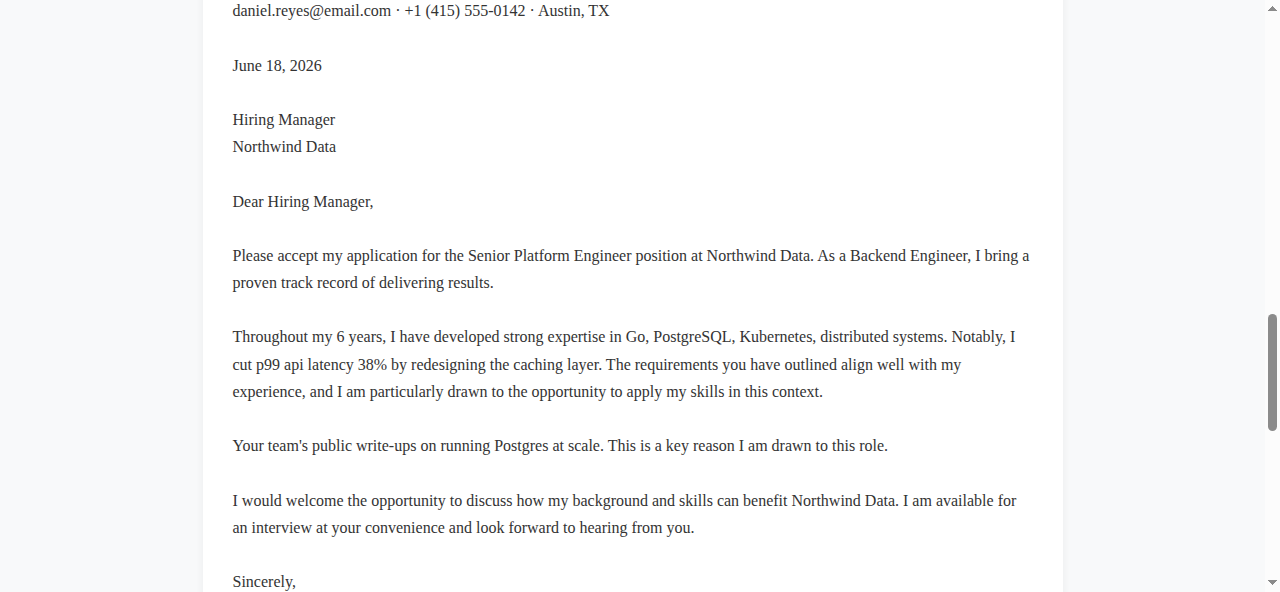
To keep the template versions consistent and fast to produce I generated the base letter with my own free Cover Letter Generator, then hand-edited the personalized half. Here is the tool producing the exact kind of structured base I started from — name, contact line, a tailored body paragraph, and a close — before I went in and rewrote the opener for the personalized group:
The reply numbers
Out of 30 applications I got 8 human replies. Here is the split:
| Group | Letters sent | Human replies | Reply rate |
|---|---|---|---|
| Personalized | 15 | 5 | 33% |
| Template | 15 | 3 | 20% |
| All | 30 | 8 | 27% |
So both confident camps are partly wrong. The "skip it, nobody reads it" crowd has to explain a 20% reply rate on plain template letters and a 33% rate on personalized ones — those numbers only move if a human is reading. And the "personalize every word or don't bother" crowd has to explain why the template group still pulled three callbacks from fifteen sends. The honest read is that a competent cover letter is worth sending, personalization helps, and the size of the help — 13 percentage points here — is real but smaller than the all-or-nothing framing implies.
The variable that actually separated them
Then I looked at the 8 replies one at a time, and a sharper pattern showed up that the group averages were hiding. Seven of the eight replies came from letters whose very first sentence named something concrete — a specific product, a specific blog post, a specific technical problem the company had described publicly. The one reply that didn't fit was a referral, where the letter barely mattered because a human had already vouched for me.
That cuts across the two groups in a way the table doesn't show. A couple of my "personalized" letters had a tailored body but still opened with a generic "I'm excited about this opportunity" line — and those underperformed the personalized average. Meanwhile, the template letters that happened to start with a concrete hook because the role itself was specific did better than the bland ones. The personalization that paid off wasn't spread evenly through the letter. It was concentrated in the opening sentence. The body could be solid-but-standard as long as the first line proved I'd actually looked at the company.
If that sounds familiar, it's because I found nearly the identical thing when I rewrote 40 LinkedIn About sections: the first couple of sentences did almost all the work and the rest of the text barely moved the numbers. Two different documents, same lesson — the reader decides whether to keep reading in the first line, so that's where the specificity has to go. Reading-behavior research has said this for years: people read a small fraction of the words on a page, skim hard, and bail early. A cover letter is read the same way an email is, and the opener is the subject line.
What "concrete first line" actually meant
To make this usable instead of vibes, here's what counted as a concrete opener in the letters that got replies, versus what didn't:
- Worked: "Your engineering post on cutting Postgres replication lag is the exact problem I spent last year on — I cut our p99 read latency 38% doing the same kind of work." Names a specific artifact, ties it to a specific result.
- Worked: "You're hiring a platform engineer to take reliability off the product teams' plates; that hand-off is the part of the job I've actually done, not just the part I'd like to do." Names the real pain in the posting.
- Didn't: "I'm excited to apply for the Senior Platform Engineer role at your company. I'm a passionate engineer with a proven track record." Generic, interchangeable, could be pasted into any application.
The winning openers all had one property: they could only have been written for that one company. The losing openers could have been sent to any of the thirty. That's the entire test. If you can swap the company name and the sentence still works, it isn't doing the job a personalized opener is supposed to do.
This also explains why personalization felt exhausting and yet the gains were modest — most people spend their personalization budget rewriting the whole letter, which is a lot of effort spread across text the reader skims. Front-load it instead. One genuinely specific opening sentence, then a clean competent body, beat a fully reworked letter with a generic open in this batch, and it takes a tenth of the time. The longer-form careers guides land in the same place: open by showing you understand the company's specific situation, not by announcing your enthusiasm.
The checklist I use now
This is what I run before sending any cover letter, mine included:
- Make the first sentence un-reusable. If you could send it to any other company unchanged, rewrite it until you can't. Name a product, a post, a problem, a number.
- Tie the specific thing to a specific result of yours. "You wrote about X; I did X and it produced Y." The hook earns attention; the result keeps it.
- Keep the body competent, not heroic. Two or three clean sentences mapping your experience to the posting's real requirements. Don't burn an hour gold-plating the part that gets skimmed.
- Cap it at one page, ideally under 250 words. Reply rate didn't reward length in this batch, and a short letter gets the opener read before anyone loses interest.
- Proofread the opener twice. A typo in the one sentence you know gets read is the worst possible place for it.
Want the whole job-search kit?
The Job Search AI Toolkit bundles 45+ tested prompts for cover letters, resume tailoring, keyword matching, interview prep, and salary negotiation — the paid companion to the free tools here.
Get the Job Search AI Toolkit — $12 →Frequently asked
Do cover letters still matter in 2026?
In this batch, yes — even plain template letters got a 20% human reply rate and personalized ones got 33%, which only happens if someone reads them. The caveat is that this was for mid-level engineering roles where a recruiter still screens applications. For very high-volume, fully automated pipelines the letter may never reach a human. When in doubt, send a short, specific one; the downside is a few minutes and the upside showed up in the numbers here.
Is it better to personalize the whole letter or just the opening?
In my test the opening line carried it — seven of eight replies came from letters that named something concrete in the first sentence, regardless of how tailored the body was. A specific opener plus a clean, competent body beat a fully rewritten letter with a generic open. Spend your effort on the one sentence that decides whether the rest gets read.
How long should a cover letter be?
Short. The letters that got replies here were around 200 words and never more than one page. Length didn't correlate with replies, and a long letter just pushes the only sentence that reliably gets read — the opener — further from the top. Lead with the specific hook, keep the body to two or three sentences, and stop.
Does generating the base with a tool make it look generic?
Only if you ship the base unchanged. A generator is good for the structure — header, a tailored body paragraph, a clean close — which is the boring part. The part that actually moves replies is the opening sentence, and that you write yourself by naming something specific about the company. Use the tool for the scaffold, write the hook by hand.
Methodology footnote
Thirty applications tracked observationally over six weeks is a pattern, not a controlled study. The sample was not randomized at the role level — I assigned treatments in alternating order, but the postings themselves varied in competitiveness, company size, and how badly they needed someone, and I could not control for that. The roles skewed toward mid-level backend and platform engineering, so the numbers may not transfer to early-career applicants, non-technical fields, or executive search where reputation drives the response. "Reply" is my own definition (a human response within 21 days), and 8 replies split across two groups of 15 is a small enough count that a single application landing differently would visibly move the percentages. The trustworthy part is the categorical pattern — concrete openers got answered, generic ones didn't, and that held across both groups — not the exact 33%-vs-20% gap. Treat the reply rates as direction, and the opening-line finding as the thing worth acting on.
Related career posts on this site
- I Tested 6 AI Cover Letter Generators — Which Ones Were Actually Usable
- I Rewrote 40 LinkedIn About Sections — Only the First 220 Characters Moved the Numbers
- I Ranked 30 Resume Bullets With 12 Hiring Managers — 5 Patterns That Won
- Free tool: Cover Letter Generator (tailored, runs in your browser)
- Free tool: Job Description Keyword Extractor
Get the opener right, then tailor the rest fast
The Job Search AI Toolkit's cover-letter and keyword prompts help you find the specific hook for each company and map your experience to the posting — so the one sentence that gets read does its job.
Get the Job Search AI Toolkit — $12 →