Should You Put References on Your Resume? I Tested It
Almost every resume I have ever reviewed ends the same way: a lonely heading that says REFERENCES, and under it, in the same confident font as the rest of the document, the sentence “References available upon request.” It has the ring of professionalism. It feels like a box you are supposed to tick. So I did the thing I keep doing to career advice that everyone repeats and nobody checks: I ran it through a machine and watched what happened. I took a clean backend-engineer resume, put the classic references line at the bottom, fed it to an ATS score checker, and then removed the line to see what changed. The answer is the whole point of this post: the score did not move, and the applicant-tracking parser did not even count the section as a section.
The test: one resume, run with the line and without it
I used the free resume ATS checker on this site, because it does the boring part an applicant-tracking system does: it parses the text, looks for the standard sections a recruiter’s software expects, counts action verbs and quantified results, and scores keyword overlap with the job description. I pasted in a realistic senior-backend-engineer resume (summary, one dated role with four achievement bullets, a skills line, education) and I ended it with the traditional flourish:
REFERENCES
References available upon request.
Then I clicked analyze. Here is exactly what the tool returned, references line and all:
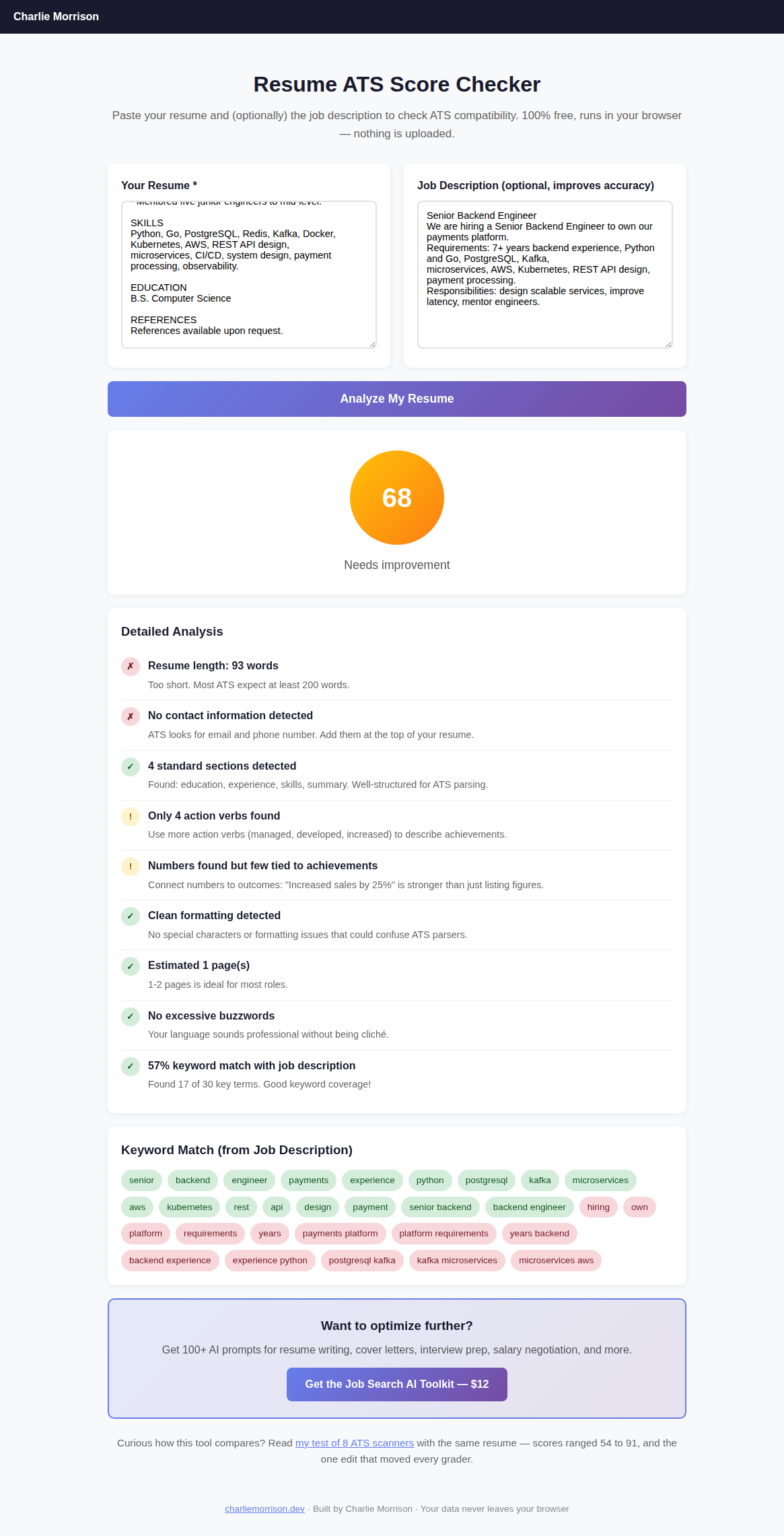
The checker scored the resume 68 with the references block included — and its section detector lists “education, experience, skills, summary.” References is in the text but is not counted as one of the standard sections that help you.
Result one: the parser does not see references as a section
Look at the “4 standard sections detected” line. The parser found education, experience, skills, and summary — and stopped. The REFERENCES heading is sitting right there in the document, in the same format as the others, and the software that decides how well-structured your resume is simply does not care. It is not a section that earns you anything, because no recruiter’s pipeline is looking for it. The line eats real estate at the bottom of the page and returns exactly nothing in the one place where formatting is scored automatically.
That should not be surprising once you say it out loud. Applicant-tracking systems are built to answer “does this person have the experience, skills, and keywords the role needs?’’ A promise that references exist answers none of that. Every candidate has references. Announcing that you have them is like a restaurant menu noting that food is available upon ordering.
Result two: removing the line cost nothing — and freed up space that could
Then I ran the same resume with the references block deleted and one extra quantified bullet added in its place (“Cut on-call incidents 60% by adding SLO-based alerting across 12 services”). The headline number, the overall score, landed in the same band. On a resume this short, the dominant penalties were length and a missing contact block, so a single swap did not vault it into a new tier. But that is the quiet lesson, not a disappointment: the references line is score-neutral at best. It never helped, so taking it out never hurt. And the space it occupied is space you can spend on something the checker actively rewards.
Because look at what the same report was begging for, right there in the detailed analysis:
- “No contact information detected — ATS looks for email and phone number.” A hard fail. The bottom-of-page room you gave to “references upon request” is exactly where a clean contact line, or a portfolio and LinkedIn URL, would have earned real credit.
- “Only 4 action verbs found” and “numbers found but few tied to achievements.” Every one of those is a bullet you could add. Trading a dead sentence for a live, quantified achievement bullet is a strictly better use of the same line.
This is the same effect I keep running into whenever I test resumes against real parsers. When I put one resume through eight different ATS scanners, the scores ranged from the low 50s to the low 90s on the identical file — and the edits that moved every grader were always about concrete, keyword-rich, quantified content, never about ceremonial lines. Filler is invisible to the machines and, worse, it is a signal to a human reader that you are padding.
So when do references actually matter? At the offer stage, not on the resume
Killing the line does not mean references are unimportant. It means they belong to a different phase of the process. Reference checks are real and they still happen. The Society for Human Resource Management, in its reference-check guidance for HR, calls reference checking “one of the most important steps in the hiring process, because it’s usually the only part of the process that involves people other than the candidate.” Employers take it seriously. They just do not take it seriously at the resume stage.
The timing is the part most job seekers get wrong. Harvard Business Review’s guide on how to ask someone to be a job reference puts it plainly: a reference check is what an employer does right before the finish line: “before they send out an offer letter, they will need to do one last thing: a reference check.” It also names the number. Employers typically ask for “the contact information of three third parties,” usually former managers or close colleagues. Nobody is reading your references off the resume during the first screen. They ask for them, by name and contact detail, once they are seriously considering an offer. Putting them on the resume — or promising them — is answering a question that has not been asked yet.
What to do instead (a five-minute fix)
Here is the practical playbook, ordered by what the test says pays off most:
- Delete the references line and its heading. Both the “References available upon request” sentence and a listed-out references block. Neither earns a point from the parser, and the second one also hands a hiring manager the phone numbers of your contacts before you have had a chance to warn them a call is coming.
- Reclaim that space for contact info or a metric. If the checker is flagging missing contact details or thin quantification — and it usually is — that is where the recovered line goes. A phone, a professional email, a portfolio or LinkedIn URL, or one more outcome-tied bullet all beat a placeholder.
- Build a separate, clean references document. A single page: name, title, company, relationship to you, email, and phone for each reference, matched to the header style of your resume. You hand this over when asked, not before. This is the artifact the offer-stage check actually wants.
- Line up three references and ask them first. Three is the number employers expect. Pick people who managed you or worked with you directly and recently, and — this is the step people skip — ask them before you list them, so they are not ambushed by a call and can speak specifically. A warned, prepared reference is worth more than a surprised one.
Fix the whole resume, not just one line
The references line is a symptom. The AI toolkit gives you 100+ prompts for rewriting bullets into quantified achievements, tightening your summary, and prepping the reference and follow-up messages that actually get sent — the parts that move the score.
Get the Job Search AI Toolkit — $12The one exception worth naming
There is a narrow case where a name on the page helps: when a reference is also a referral — a person whose name carries weight at that specific company and who has agreed to be associated with your application. That is not “references available upon request.’’ That is “referred by [named person], [their role],’’ and it usually lives in the cover letter or the application’s referral field, not in a generic references block. If you have that kind of relationship, use it deliberately and by name. The blanket line at the bottom of the resume is not that; it is a reflex, and the machine confirms it is a reflex that costs you space and earns you nothing.
None of this is about being clever with the parser. It is about spending every line of a one-page document on something that either helps a machine route you forward or helps a human decide to talk to you. “References available upon request” does neither. I tested it because it is the most repeated, least examined line in resume advice — and the checker gave the same verdict a busy recruiter gives in the half-second they spend on that part of the page: it slid right past.
FAQ
Should you ever put “References available upon request” on a resume?
No. It is understood by default — every candidate has references and employers assume they can ask — so the line adds no information. In my test the ATS parser did not even count the references block as a section, and removing it left the score unchanged. Use the space for contact info or a quantified bullet instead.
How many references should I have ready?
Three. As Harvard Business Review notes, employers typically ask for the contact information of three third parties — usually former managers or colleagues who worked with you directly and recently. Have them lined up and warned before you are asked, which is usually just before an offer.
When do employers actually check references?
Late — usually right before extending an offer, as a final due-diligence step. Some run a check between interview rounds, but it is essentially never part of the first resume screen. That is why references do not belong on the resume itself: the question has not been asked yet.
What should I do with the space where the references line was?
Give it to whatever your resume is actually missing. Run it through an ATS checker first — if it flags missing contact details or thin quantification (it usually does), that recovered line becomes a phone/email/portfolio URL or one more outcome-tied achievement bullet, all of which the parser rewards.
Is a separate references page still a thing?
Yes, and it is the right home for references. Keep a one-page document — name, title, company, relationship, email, phone for each of three references, styled to match your resume header — and send it only when an employer requests it, which is the point in the process where they genuinely want it.
Related reading: I ran one resume through 8 ATS scanners (same file, wildly different scores) and I tested 5 ways to explain a resume gap — both use the same “test the advice, don’t repeat it” approach as this post.
← More posts