Promoted With No Raise? I Ran the "Title but Not the Pay" Scenario Through My Own Salary Tool
There is a version of a promotion that feels like a demotion. You get the new title, the bigger scope, the extra head or two reporting to you, and the same number on your paycheck. Management calls it a "growth opportunity." You call it doing two jobs for one salary. It is one of the most common money conversations in a career, and it is almost never the one the internet writes scripts for. Search "salary negotiation" and you drown in advice about countering a job offer from a company you do not work for yet. The internal version, where what you have to bargain with is completely different, gets a fraction of the coverage.
So I ran it through a tool instead of theorizing about it. I have a free salary negotiation script generator on this site with a "Negotiating a promotion" scenario built in, and I have never actually pointed a realistic case at it and read what came back. This post is that experiment: one frozen scenario, the raw output, and what the machine got right and wrong about a conversation most people fumble.
The scenario I froze
I wanted something ordinary, not a dramatic underdog story. Here is the person I built:
- Role: just promoted from Marketing Manager to Senior Marketing Manager
- Industry: Tech / SaaS
- Current pay: $78,000 (unchanged after the promotion)
- Target: $95,000
- Experience: 6 years
- Evidence on hand: grew qualified pipeline 42% in three quarters, built a lifecycle-email program now driving 18% of new revenue, kept a three-person team through a reorg with zero attrition
Those three achievements matter more than they look. In a new-offer negotiation what you bargain with is the competing offer or the market rate for a stranger. In a promotion negotiation you have neither of those working cleanly, because your employer already has you and already knows what they pay you. Your only real card is proof you are already operating at the level they just named you at. I picked the "Data-Driven & Analytical" tone because, in an earlier test I ran on the same tool, that tone read the most human and leaned hardest on concrete numbers. Then I hit generate.
What the tool actually produced
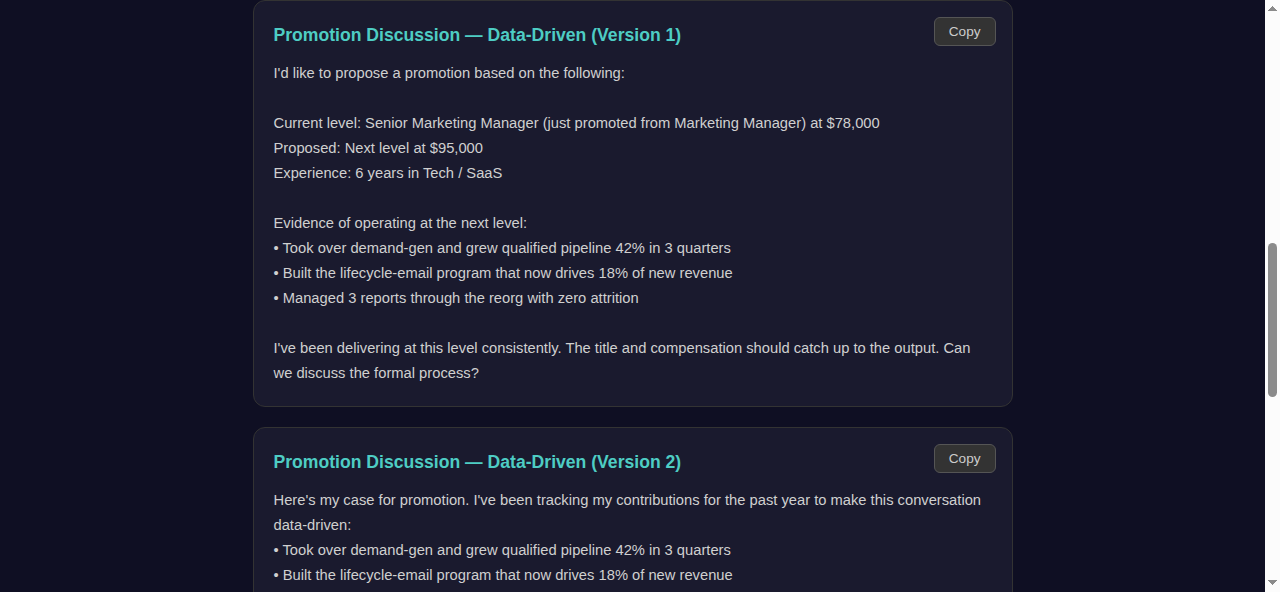
The generated promotion script, data-driven tone. It leads with evidence of operating at the next level before it ever names the number.
Here is the opening version it wrote, quoted verbatim:
I'd like to propose a promotion based on the following:
Current level: Senior Marketing Manager (just promoted from Marketing Manager) at $78,000
Proposed: Next level at $95,000
Experience: 6 years in Tech / SaaS
Evidence of operating at the next level:
• Took over demand-gen and grew qualified pipeline 42% in 3 quarters
• Built the lifecycle-email program that now drives 18% of new revenue
• Managed 3 reports through the reorg with zero attrition
I've been delivering at this level consistently. The title and compensation should catch up to the output. Can we discuss the formal process?
The line I did not expect, and the one that carries the whole thing, is the second-to-last: "The title and compensation should catch up to the output." That is the exact frame a promotion-raise conversation needs. You are not asking for a favor. You are pointing out a lag between what you deliver and what you are paid, and asking the company to close it. The evidence bullets sit above the number so the manager reads the justification before the ask, which is the correct order. A second version it generated opened with "Here's my case for promotion. I've been tracking my contributions for the past year to make this conversation data-driven," which does the same work with a slightly warmer on-ramp.
What it got right
Three things, and they are the three things people skip when they wing this conversation.
- It led with delivered results, not potential. A promotion ask built on "I'll take on more" is weak because the company can simply say "great, do it and we'll revisit later." An ask built on "I already grew pipeline 42%" is a fact they have to argue with. Indeed's promotion-salary guidance lands on the same rule: justify the number with quantifiable contributions and accolades, not adjectives (Indeed on negotiating a promotion salary).
- It named a specific target. $95,000, not "a raise" or "market rate." A vague ask invites a vague answer, and the vague answer is almost always smaller than the specific one you would have asked for. Harvard Business Review's long-running negotiation guidance makes the same point about anchoring with a concrete, defensible figure rather than a feeling (HBR's 15 rules for negotiating an offer).
- It asked about the process, not just the money. "Can we discuss the formal process?" is smarter than "Can I get to $95K?" because internal raises usually route through comp bands, HR sign-off, and a review cycle. Getting your manager to open the process is often the real unlock. The number follows.
Where the tool stops and you have to take over
The script is a strong opening, but it is an opening, not the whole negotiation. Two gaps I would close by hand before sending anything like it.
It does not know your market number. The tool took my $95,000 target at face value. It has no idea whether that figure is aggressive, conservative, or delusional for a Senior Marketing Manager with six years in SaaS. That homework is on you, and it is the part that actually determines the outcome. Pull real bands from Glassdoor, Payscale, or Levels before you anchor. And go in eyes-open about the baseline: Indeed's data puts a typical internal promotion raise at only around 3%, while switching companies tends to pay 10% to 20% (Indeed on the average promotion raise). If you are asking for a jump from $78K to $95K, that is roughly 22%, which is a job-switch-sized move you are asking your current employer to make. That does not make it wrong. It makes it a number you had better be able to defend with the band, not just with effort.
It does not handle the pushback. The generated script gets you to the table. It says nothing about what you do when your manager says "there's no budget until the next cycle" or "that's above the band for the role." Decide your responses in advance. If it is a budget-timing objection, pin a specific revisit date and a specific number in writing. If it is a band objection, that is your cue to ask what it would take to move into the next band, which quietly reframes the conversation from "no" to "when." A script cannot improvise that for you because it does not know what they will say.
The honest verdict
For a conversation that most people delay for months because they do not know how to open it, the generated script is genuinely useful. It solves the blank-page problem, it orders the argument correctly (evidence, then number, then process), and it produced a line I would actually keep. What it cannot do is the research that makes the number credible or the composure that survives the first "no." Treat it the way you would treat a good first draft from a sharp colleague: a real head start, not a finished plan. The generator gets you talking; the market data and your nerve get you paid.
Stop staring at the blank page
The Job Search AI Toolkit bundles the prompt frameworks I use to draft raise cases, promotion asks, and offer counters, plus the market-research checklist that keeps the number defensible.
Get the Job Search AI Toolkit — $12FAQ
Should I bring up pay when they announce the promotion, or wait?
Bring it up as part of accepting, not weeks later. Once you have said yes at the current salary, you have signaled the title alone was enough. A clean line: "I'm excited about this. Given the added scope, I'd like to talk about how compensation catches up to the new level." You can accept the role and open the money conversation in the same breath.
What if there is genuinely no budget right now?
Get a specific commitment instead of a vague promise. A dated review with a target number in writing ("we'll revisit at $90K in the Q1 cycle") is worth far more than "we'll see." If they will not put anything concrete in writing, that is information about how the raise will actually go.
Is a 20%+ jump for an internal promotion unrealistic?
It is above the typical 3% internal bump, so you cannot lean on "that's normal." You have to lean on the band: show that peers at the new title, at your experience, are paid in that range, and that your current pay is below it. If the market data backs the number, the size of the jump is their problem to justify, not yours.
Related reading: I generated 30 salary negotiation scripts to see which openings recruiters respond to, what happened across 38 counter-offer negotiations, and how I answered the salary-expectation question 12 ways. All three use the same "run the advice, don't just repeat it" approach as this post.
← More posts