I Renamed My Resume Headings and the ATS Score Dropped 13 Points
There is a certain kind of resume advice going around that tells you to stand out with personality — to swap the boring old Work Experience heading for something with a bit of voice. Where I’ve Made an Impact. My Story. What I Bring to the Table. It reads well to a human. It feels like the sort of small differentiator that makes a tired recruiter smile. So I did what I keep doing to advice that sounds nice and gets repeated without anyone checking it: I ran it through a machine. I took one finished resume, scored it, then changed only the four section headings — not a single other word — and scored it again. The number moved, and it moved the wrong way. Thirteen points, straight down.
The test: one resume, two sets of headings
I used the free resume ATS checker on this site, because it does the same unglamorous job an applicant-tracking system does before a human ever sees your file: it parses the plain text, hunts for the standard sections a recruiter’s software expects, counts action verbs and quantified results, and scores keyword overlap against the job description. I pasted in a realistic senior-backend-engineer resume — a summary, two dated roles with achievement bullets, an education line, and a skills list — alongside a matching “Senior Software Engineer” job posting asking for Python, AWS, Docker, and PostgreSQL.
Run one used the plain, expected headings:
Professional Summary · Work Experience · Education · Skills
Run two was the exact same document, byte for byte, with only those four labels reworded into something with more personality:
About Me · Where I’ve Made an Impact · My Academic Journey · What I Bring to the Table
Every bullet, every keyword, every date, every number was identical. The only variable was the wording of four headings. Here is what the checker returned on the “creative” version:
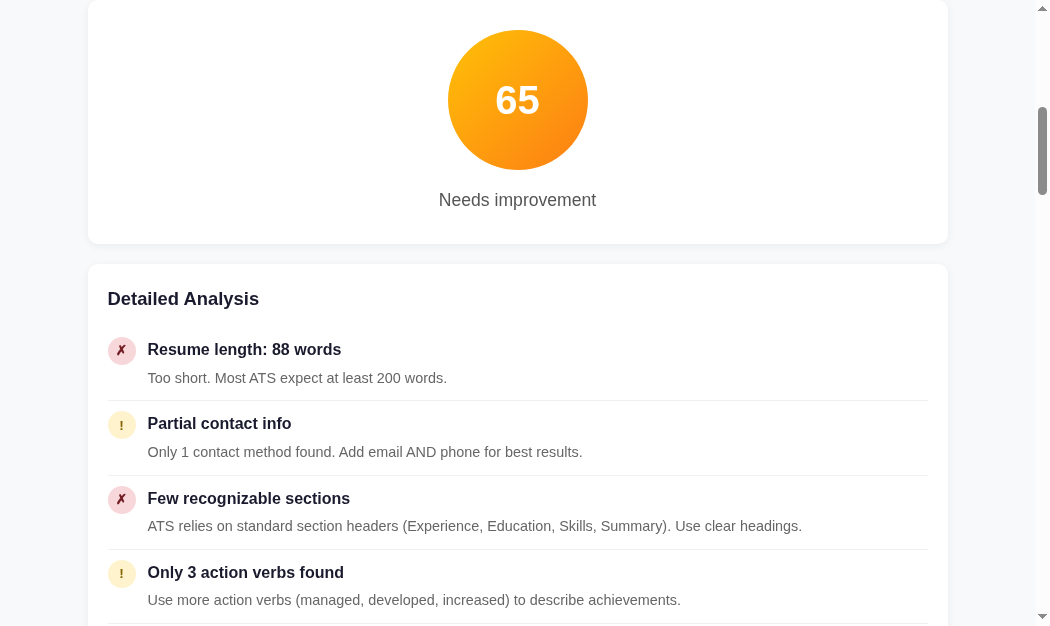
Same resume, personality headings: the checker drops to 65 and flags “few recognizable sections.” With standard headings the identical file scored 78 and reported “6 standard sections detected.”
The result: a 13-point swing from headings alone
The two runs are worth putting side by side, because nothing else about them differs:
| What changed | Standard headings | Personality headings |
|---|---|---|
| Overall score | 78 — “Strong ATS compatibility” | 65 — “Needs improvement” |
| Section detection | “6 standard sections detected” (summary, experience, work experience, education, skills, professional summary) | “Few recognizable sections” |
| Everything else | Identical — same bullets, keywords, dates, and skills | |
Thirteen points is not a rounding error. It is the difference between a report that says “strong” and one that says “needs improvement,” produced by nothing more than renaming four lines. The parser found the content just fine in both cases — the words were all there — but it lost the map. It could no longer confidently say “this block is your work history, that block is your education,” so it downgraded how well-structured the resume looked.
Why the machine cares so much about four words
An applicant-tracking system does not read your resume the way a person does. It slices the document into segments and tries to file each one under a known label so a recruiter can later search “show me candidates with 5+ years in the experience section.” Standard headings are the signposts that make that filing reliable. Indeed’s own guide to writing an ATS resume is blunt about it: the system relies on conventional headings like “Work Experience,” “Education,” and “Skills” to pinpoint your qualifications, and clever alternatives make that harder.
When the signpost is missing, the failure mode is not always “the section vanishes.” Sometimes it is worse: your job history gets misfiled under the wrong category entirely. Jobscan’s breakdown of common ATS formatting mistakes describes exactly this — non-standard headings can leave an ATS categorizing your work experience under education, or dropping a professional summary it no longer recognizes. My test is the mild, visible version of that: the checker did not misfile anything, it simply stopped counting the blocks as standard sections and marked the resume down for it. On a stricter real-world parser, “Where I’ve Made an Impact” could quietly land your best role in the wrong bucket, and you would never know why the callbacks stopped.
This is the same lesson every parser test keeps teaching
I keep running these little experiments, and they converge on one boring truth: the machine rewards convention, not creativity, in the structural parts of a resume. When I tested whether the classic “references available upon request” line did anything, the parser did not even count it as a section — ceremonial text is invisible to it. When I compared PDF versus Word files through the same checker, the reliable, boring format won. Headings are the third instance of the identical pattern. The place to be interesting is inside the bullets — the quantified outcome, the specific keyword, the number tied to a result. The place to be utterly conventional is the scaffolding: the section labels, the file type, the contact block. Spend your originality where a human reads it, not where a machine files it.
The headings that actually parse
You do not need many, and you do not get points for inventing new ones. Use the plain labels a parser has been trained on for twenty years:
- Professional Summary (or just Summary) — the two-line pitch at the top.
- Work Experience (or Experience / Professional Experience / Employment History) — all safe, all recognized.
- Education — do not get cute with this one.
- Skills (or Technical Skills) — the keyword-dense list the ATS matches against the posting.
- Certifications and Projects — optional, but if you use them, use those exact words.
That is the whole vocabulary. Notice that several of these have accepted synonyms — “Experience” and “Professional Experience” both parse — so you have a little room to match the tone of a role without leaving the recognized set. What you cannot do is replace the category with a phrase, because a phrase is what breaks the map.
Check your own headings in 30 seconds
The free ATS checker on this site flags exactly what my test caught — unrecognized sections, missing contact info, thin quantification — on your real resume, before a recruiter’s software does. If you want the next step, the Job Search AI Toolkit has 100+ prompts for turning weak bullets into the quantified achievements that actually move the score.
Get the Job Search AI Toolkit — $12The one place a creative heading is fine
There is exactly one part of a resume where a bit of voice in the label does no harm: a genuinely optional, non-standard block that the parser was never going to file anyway — a short “Selected Projects” showcase, a “Speaking” list, a personal note at the very bottom. The ATS is not looking for those, so whether you call them “Projects” or “Things I’ve Built” changes nothing in the score; it only speaks to the human who reads later. But the four load-bearing sections — summary, experience, education, skills — are the ones the machine routes on. Those get the plain names, every time. Save the personality for a bullet that says you cut deployment time 40%, not for a heading that hides where you did it.
None of this is about gaming the parser. It is about not tripping over it for no reason. “Where I’ve Made an Impact” is a lovely phrase and it cost me thirteen points for zero benefit, because the one reader who could not appreciate it was the one who decides whether a human ever sees the page. I tested it because it is exactly the kind of advice that sounds like an edge and is actually a tax. The checker gave the same verdict a busy ATS gives in the millisecond it spends filing your resume: nice words, wrong place.
FAQ
Do resume section headings really affect an ATS score?
Yes. In my test, changing only the four section headings on an otherwise identical resume dropped the checker’s score from 78 (“strong”) to 65 (“needs improvement”), because the parser stopped recognizing the blocks as standard sections. The content was unchanged; only the labels moved the number.
What are the safe, ATS-friendly section headings?
Professional Summary (or Summary), Work Experience (Experience / Professional Experience / Employment History all parse), Education, Skills, and optionally Certifications and Projects. Use those exact words. Indeed and Jobscan both note that ATS software relies on these conventional labels to file your qualifications.
Can a creative heading actually hurt my application?
It can. Beyond a lower structure score, a non-standard heading can cause a stricter ATS to misfile a section — for example, categorizing your work experience under education or dropping a summary it no longer recognizes. That misrouting happens silently, so you never learn it is why you stopped getting callbacks.
Is “Experience” as good as “Work Experience”?
Yes. “Experience,” “Work Experience,” “Professional Experience,” and “Employment History” are all in the recognized set, so you have room to match a role’s tone without breaking parsing. What fails is replacing the category with a phrase like “Where I’ve Made an Impact.”
How do I know if my own headings parse?
Run your resume through an ATS checker and look at its section-detection line. If it reports fewer sections than you actually have, or flags “few recognizable sections,” a heading is the likely culprit — rename it to the standard label and re-run.
Related reading: I ran one resume through 8 ATS scanners (same file, wildly different scores) and should you put references on your resume? — both use the same “test the advice, don’t repeat it” approach as this post.
← More posts