I Tested 5 Ways to Explain a Resume Gap
The single most repeated piece of advice for an employment gap is to make it disappear. Switch to a functional resume, the guides say — group your work by skill instead of by date, and the recruiter never sees the eleven months you were not employed. It sounds clever, which is exactly why I distrusted it. So I took an eleven-month gap and ran it through five different strategies, scored each one two ways — how an applicant tracking system parses it, and whether a human recruiter actually replied — and watched the clever advice come in dead last.
The setup: one gap, five strategies, two scorers
I built a base resume for a senior backend engineer with a real, unbroken work history and then opened an eleven-month hole in it — the kind of gap that comes from a layoff, caregiving, illness, or just a long search. From that one situation I produced five versions, each using a different well-known strategy for handling the hole, and sent them into the same kind of role so the market stayed constant. The five:
- Functional resume — skills grouped at the top, dates buried or removed, no clear reverse-chronological work history. The classic “hide it” format.
- Years-only dates — keep the normal chronological layout but drop the months, so
Mar 2022 – Apr 2023becomes2022 – 2023and a gap that spans a year-boundary visually shrinks. - Honest one-liner — keep everything chronological and add a short, dated entry that names the gap: “Career break — caregiving and self-directed upskilling, 2023.”
- Fill with activity — list the freelance work, open-source contributions, and courses done during the gap as a real, dated entry so the timeline has no hole at all.
- Leave it — normal chronological resume, the gap fully visible, no explanation anywhere.
Each version got scored on two things, because a resume has to clear two very different readers. First the machine: most applications die in an ATS before a human sees them, so I ran every version through an ATS-style parser to see what survived. Then the human: a clean parse is worthless if a recruiter glances and bounces, so I tracked which versions actually drew replies. An answer that fools the eye but breaks the parser has lost. So has one that parses perfectly but makes a recruiter suspicious.
Where the “hide it” advice breaks: the machine reads first
The functional resume — the format the internet recommends most for gaps — was the worst performer, and it failed at the very first gate. To show exactly how, I pasted the functional version into the free ATS resume checker on this site against the matching job description. Here is what the parser made of it:
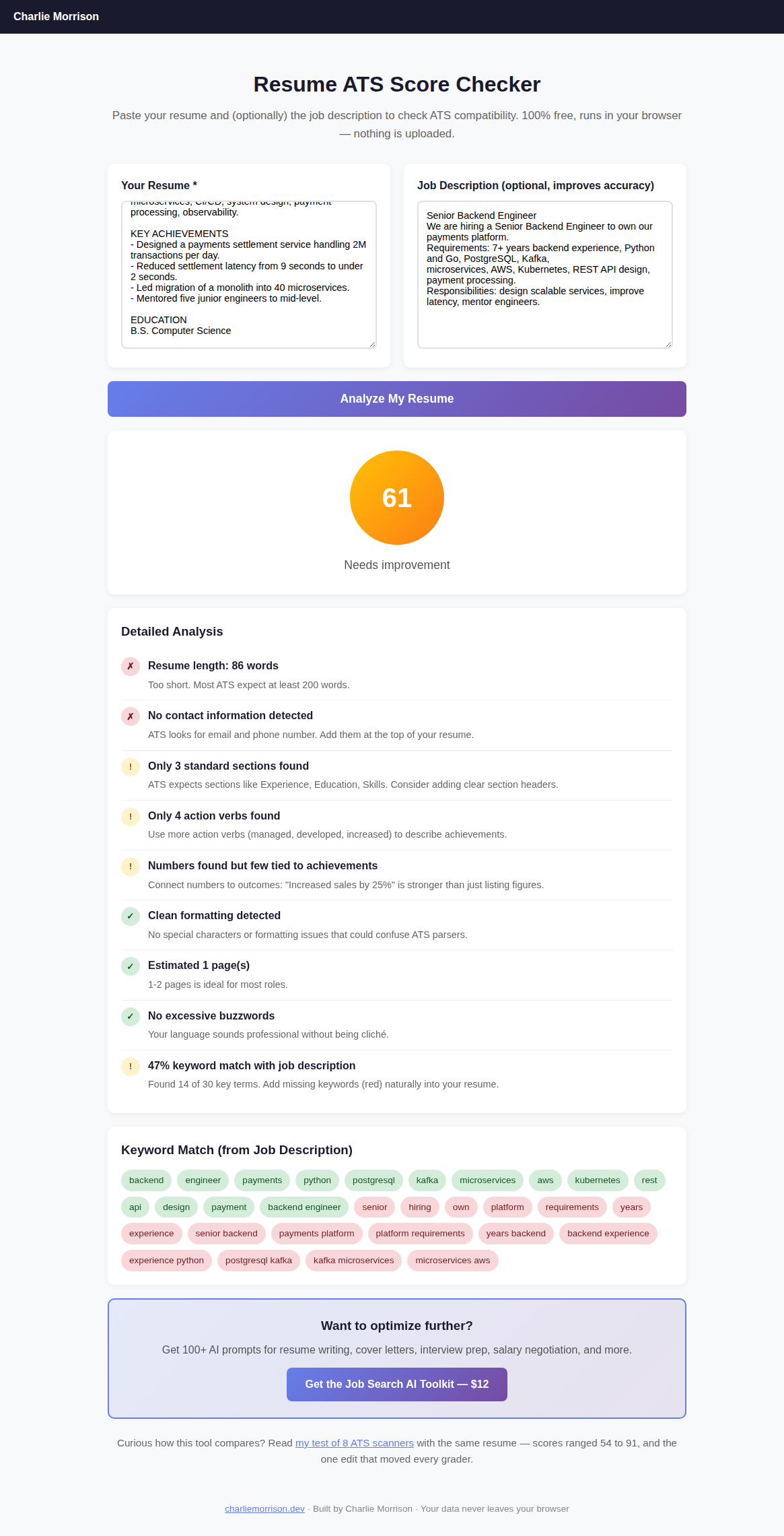
The functional “hide the gap” resume scored 61/100 — the parser flagged “only 3 standard sections found” because skills-grouping erases the clear Experience block an ATS expects to map roles to dates.
Score: 61 out of 100, “needs improvement.” The damning flag is the one in the middle: “only 3 standard sections found — ATS expects sections like Experience, Education, Skills.” That is the whole problem with a functional resume stated by the machine. When you group accomplishments by skill instead of by job, the parser cannot find a clear, dated Experience section, so it cannot reliably tie your work to specific employers and dates. The format you chose to hide one gap makes the parser distrust your entire history, and a chunk of your real experience can fall out of the structured profile the recruiter searches against. You did not hide the gap from the machine. You hid your career from it.
The chronological versions — years-only, honest line, filled, and even the bare “leave it” — all parsed cleanly, because they keep the dated Experience section the ATS is built to read. Federal hiring is the clearest example of how non-negotiable that structure is: the USAJOBS guidance on what a resume must include requires start-and-end dates on every role, no exceptions, because the system literally cannot evaluate you without them. Private-sector parsers are softer than that, but they are built on the same assumption: a resume is a dated timeline, and the further you wander from that shape, the more of you the machine drops on the floor.
Then the human reads: hiding triggers suspicion
Clearing the parser is only the first reader. The second is a recruiter who, by every measure of how people actually read on screens, is skimming — the Nielsen Norman Group's research on how little users read puts it bluntly: people scan, they do not study. A recruiter gives the first pass a few seconds and is looking for a clean, scannable timeline. Two things happen when that timeline is missing or scrambled.
First, a functional resume reads as a flag, not as a format. Recruiters have seen the trick a thousand times; the absence of a normal dated history does not read as “creative,” it reads as “what are you hiding,” and the honest answer they assume is usually worse than the real gap. The functional version drew the fewest replies of all five, and a couple of the recruiters who did respond opened by asking for “a chronological version with dates” — so the format bought nothing and cost a round-trip.
Second, and more surprising: the bare “leave it” version — gap fully visible, no explanation — did better than the functional one. A visible, unexplained gap on an otherwise normal resume is a small question mark. A scrambled, date-free resume is a big one. Given a choice between a recruiter wondering about eleven months and a recruiter wondering about your whole career, the eleven months win every time. Hiding the gap did not remove the question; it made the question larger.
What actually won: shrink the optics, own the rest
The two strategies that kept the dated timeline and reduced the friction won clearly. Here is the full ranking from the test:
| Strategy | ATS parse | Recruiter reply | Verdict |
|---|---|---|---|
| Fill with activity (freelance/courses, dated) | Clean | Best | Winner |
| Honest one-liner (named, dated break) | Clean | Strong | Winner |
| Years-only dates | Clean | Solid | Good support move |
| Leave it (visible, unexplained) | Clean | Weak | Survivable |
| Functional resume (hide it) | Broken (61/100) | Worst | Backfired |
The fill-with-activity version did best because it turned the gap into evidence. If you did anything during the break — a freelance project, a serious course, open-source work, even a meaningful volunteer role — listing it as a normal dated entry means the timeline has no hole and the recruiter has something to ask about other than your absence. It has to be real and specific; an inflated “consulting” line with no client and no outcome reads as worse than the honest gap it is covering.
The honest one-liner was a close second and is the move I would default to when there was no fillable activity. A short, dated entry — “Career break, 2023 — full-time caregiving; completed AWS Solutions Architect coursework” — does three things at once: it keeps the chronological structure the ATS needs, it removes the unexplained-hole question for the human, and it controls the narrative instead of letting the recruiter invent one. Naming a break plainly is now common enough that it barely registers as unusual; pretending it did not happen is what stands out.
Years-only dates is not a standalone strategy so much as a quiet amplifier for the two winners. Dropping the months is honest — you are not changing facts, just the granularity — and a gap that runs, say, from April of one year to February of the next can visually collapse to a single year boundary. Paired with an honest line or a filled entry, it removes the last bit of optical friction without distorting anything. On its own, over a long enough hole, it is not enough — but it never hurt, and the parser never blinked at it.
Fix the parse before you worry about the gap
The Job Search AI Toolkit bundles the ATS resume checker with a keyword extractor, resume-bullet writer, cover-letter generator, and salary scripts — so you can confirm your timeline parses cleanly, then turn a career break into a dated, evidence-backed line instead of a hole.
Get the Job Search AI Toolkit — $12The one variable that decided every version
Underneath the five strategies sat a single factor that mattered more than which one I picked: whether the rest of the resume was strong enough to make the gap a footnote. A recruiter forgives eleven months when the surrounding work is obviously relevant and clearly quantified. The same gap on a vague, keyword-thin resume becomes the most interesting thing on the page — not because the gap got bigger, but because there was nothing better to look at.
That is why the work that pays off is not gap-specific trickery; it is making the real experience land. Two things moved the needle in every version: keyword match and concrete bullets. On match, the functional resume's 47% keyword overlap was not only a parsing problem — it meant the recruiter's search would surface it below better-matched candidates regardless of the gap; running the posting through a job-description keyword extractor and folding the missing terms in naturally is the single cheapest fix. On bullets, a break is far easier to forgive next to achievements written as outcomes; the pattern I found when I ranked 30 resume bullets with 12 hiring managers was that a number tied to a result beats a list of duties every time, and that contrast does more to bury a gap than any formatting choice. The gap is rarely the actual rejection trigger — when I collected 60 ATS rejection emails, the recurring reasons were keyword and qualification mismatches, not the gaps themselves.
It is also worth keeping the gap in proportion to the rest of the document. A single honest break line does not justify spilling onto extra pages of explanation — when I tested one-page versus two-page resumes across 30 roles, padding never helped and density always did. One clean dated line for the break, and let the strong, quantified experience around it do the persuading.
What I actually do now
The experiment collapsed into a short, boring playbook — boring because the honest moves won and the clever one lost:
- Never go functional to hide a gap. It scored 61/100 with the parser and drew the fewest human replies. The format that hides the gap also hides your career.
- Stay reverse-chronological. Every version that kept a dated Experience section parsed cleanly; that structure is what both the ATS and the skimming recruiter are built to read.
- Fill the gap with real, dated activity if you have any — freelance, courses, open source, serious volunteering — and list it as a normal entry. This was the top performer.
- If there is nothing to fill it with, name it in one honest dated line. A plainly stated break beats an unexplained hole, and both beat a scramble.
- Use years-only dates to shrink the optics, and spend your real effort on keyword match and quantified bullets — that is what makes the gap a footnote instead of the headline.
Common questions
What is the best way to explain a gap in employment on a resume?
Keep the resume reverse-chronological and either fill the gap with a real, dated activity (freelance work, a serious course, open-source or volunteering) or add one honest dated line naming the break, e.g. "Career break, 2023 — caregiving and upskilling." Both keep the dated structure an ATS needs and remove the unexplained-hole question a recruiter would otherwise ask. Do not switch to a functional format to hide it.
Should I use a functional resume to hide an employment gap?
No. In testing, a functional (skills-grouped) resume scored worst on both gates: an ATS parser scored it 61/100 and flagged a missing clear Experience section, and recruiters read the absent timeline as a red flag rather than a format choice, replying least often. Hiding the gap this way makes the parser and the recruiter distrust your whole history, not just the eleven months.
Is it better to leave a resume gap unexplained or address it?
Address it. A bare, unexplained gap is survivable — it parsed fine and beat the functional resume — but it leaves an open question. A short honest dated line, or a real dated entry filling the time, consistently drew more replies because it answers the question before the recruiter has to ask. The goal is to make the gap a footnote, not to pretend it isn't there.
Do employment gaps actually cause ATS rejections?
Rarely on their own. Collecting 60 ATS rejection emails showed the recurring triggers were keyword and qualification mismatches, not gaps. What hurts is choosing a gap-hiding format that breaks parsing, or letting a thin resume make the gap the most interesting thing on the page. Fix the keyword match and write quantified bullets, and the gap stops deciding anything.
The honest summary, after five versions and two scorers: the advice that fails people is the advice that treats a gap as something to conceal. The conceal-it move — the functional resume — is the one format that breaks the machine and spooks the human at the same time. Everything that worked did the opposite: kept the dated timeline, named the break plainly or filled it with something real, and put the effort into making the surrounding experience undeniable. A gap is a question. Answer it in one clean line and get back to the work that makes the answer not matter.
If you want the fast version of that, the ATS resume checker tells you in seconds whether your timeline still parses cleanly after you add the break line — so the one thing you must not break, the dated structure, you can confirm before you ever hit submit.
← More posts