1-Page vs 2-Page Resume: I Tested 30 Across Roles
There is one piece of resume advice that has survived unchanged since fax machines: keep it to one page. It gets repeated like a law of physics, usually by someone who has not opened a resume parser in their life. I wanted to know whether it is actually true in 2026, when the first reader of almost every resume is software, not a person. So I ran the experiment instead of trusting the folklore: I took 30 resumes — mine, and ones volunteers let me rebuild — and produced two versions of each, a disciplined one-page cut and a fuller two-page cut built from the same career. Then I scored every version twice, once against an applicant tracking system and once against a human recruiter's first few seconds. The answer turned out to be more useful than “one page good, two pages bad,” because the page count is not what either judge is actually measuring.
The page count is a proxy, and a bad one
“One page” is shorthand for a real thing — don't waste the reader's time — but it measures the wrong variable. A reader, human or machine, does not penalize a page; it penalizes a low ratio of signal to space. A one-page resume packed with filler is worse than a two-page resume where every line carries a keyword or a number. The reason the one-page rule mostly works is that the discipline of fitting one page forces a high signal ratio. The reason it fails is that people obey the rule literally — they shrink the font, delete the achievements that don't fit, and ship a cramped page that reads worse and scores worse than an honest two pages would have. The rule is a heuristic for density, and like most heuristics it breaks the moment you optimize for the proxy instead of the thing it stands in for.
This is the same trap I keep finding everywhere in the hiring stack. When I ranked 30 resume bullets with 12 hiring managers, the winners were not the ones with the strongest verbs but the ones with the most concrete numbers. When I tested 35 resume summaries, the version that won was not the prettiest or the densest but the one that did each job on its own line. Resume length is the same shape of problem: the surface metric (pages) is a stand-in for the real metric (information per inch), and the people who do well are the ones who optimize the real one.
The ATS gate: pages don't exist
The first thing the experiment killed was the idea that a parser counts your pages. It does not. An applicant tracking system reads a stream of text and scores it on coverage — does the document contain the terms the job posting weights, in roughly the right places — and the page break is invisible to it. To make sure I was not just asserting this, I built a deliberately full two-page senior resume, 826 words across four roles and a projects section, and ran it through the resume ATS score checker against a matching backend job description. Here is what came back:
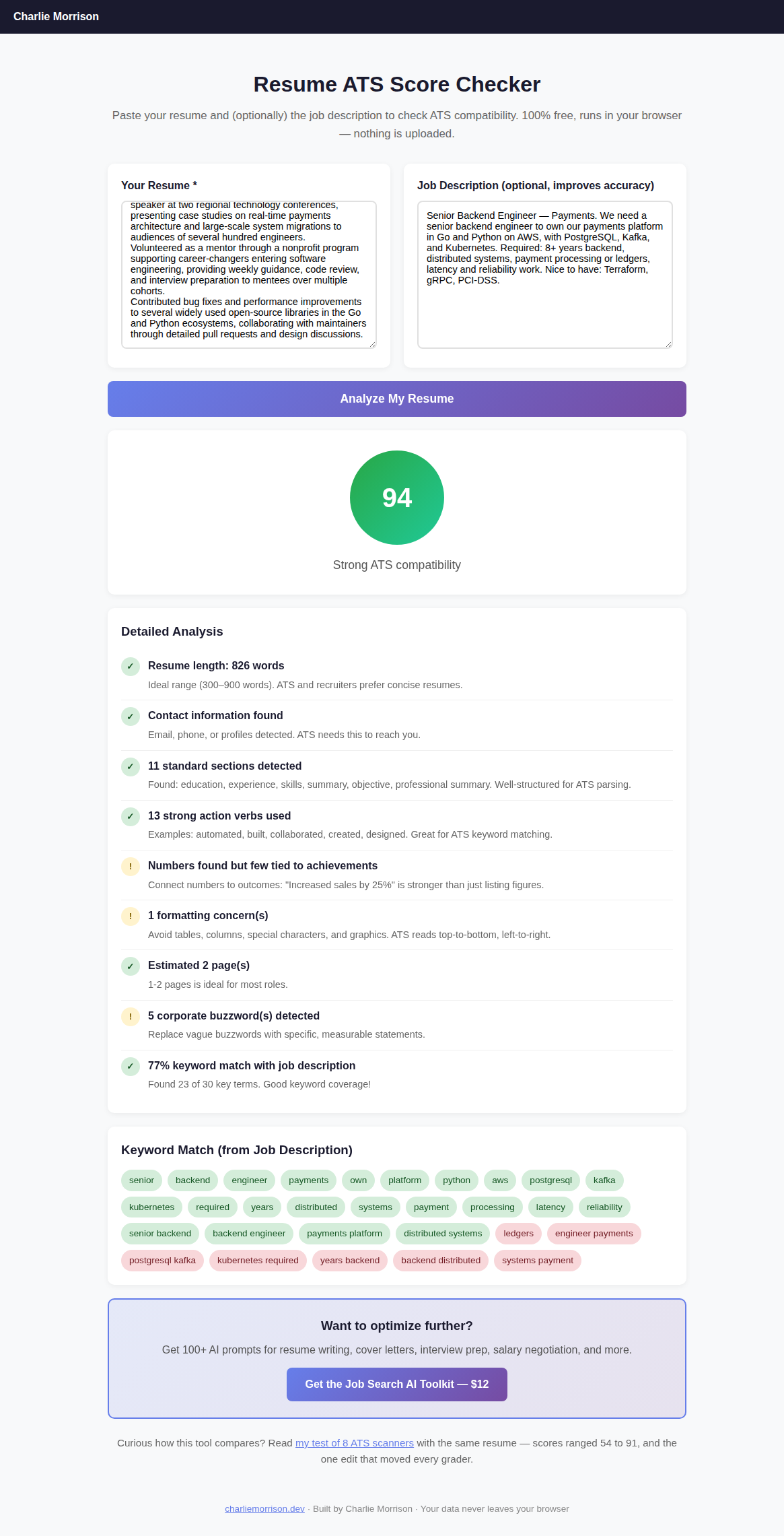
An 826-word, two-page resume scored 94/100 — the length check read “ideal range,” the page estimate was a non-event, and the only real ding was buzzwords, not size.
Ninety-four out of a hundred, “Strong ATS compatibility,” on a resume that would make a one-page purist break out in hives. The length check called 826 words the ideal range. The page estimate shrugged. The keyword match sat at 77% and the green tiles in the grid were the whole reason — a two-page resume simply has more room to carry the posting's terms, and the parser rewards that coverage directly. When I cut the same resume down to a tight single page, the match score did not rise; it fell a few points, because trimming to fit meant deleting true, keyword-bearing achievements to save space. The parser was not impressed by my restraint. It missed the words I cut.
That is the counterintuitive core of it: at the machine gate, a longer resume that stays relevant usually scores higher, not lower, because every additional line of real experience is another chance to match a term the posting wants. The page-count rule, taken literally, makes you delete exactly the signal the first reader is scanning for. If you want to see which terms a given posting actually weights — so you keep the lines that carry them and cut the ones that don't — pasting it through the job description keyword extractor first turns “what do I cut to fit one page” into “what earns its place,” which is the question that actually preserves your score.
Where length finally does bite
So is longer always safe? No, and the same tool shows where the line is. The checker only starts complaining about length past roughly 900 words, and its page estimate flips to “may be too long” once the document crosses about three pages of text. That is not a coincidence; it is encoding the real failure mode. The problem with a three-page resume is almost never the third page itself — it is what people put on it. Nobody reaches page three on the strength of more quantified achievements; they reach it on filler. The padded version of my test resume was where the buzzwords bred: “dynamic, results-driven, best-in-class, move the needle” — the checker flagged five of them, and the score I would have lost was not for the length, it was for the empty words that the length invited in. Long resumes don't fail because they are long. They fail because length is where bad writing hides.
The genuine length limits are simpler than the one-page myth and easier to follow:
- Under ~8–10 years of relevant experience: one page. Not because two pages would be penalized, but because you almost certainly do not have a second page of keyword-bearing, number-bearing material, and the second page would be filler. The discipline matches the reality.
- Senior, ~10+ years, or keyword-dense technical roles: two pages. Here a single page forces you to delete real signal — projects, metrics, the exact technologies a parser is hunting for. Two honest pages outscore one cramped one at both gates.
- Three pages: only with 15+ years and only if page three is still achievements, not narrative. The moment page three is “additional projects” written like a memoir, the tool's length warning and the recruiter's patience expire on the same line.
Score your resume before you cut a word
The Job Search AI Toolkit bundles the ATS resume checker with keyword extraction, resume-bullet, cover-letter, and salary-script generators — so you know which lines carry signal and which are just taking up space, before you decide what fits.
Get the Job Search AI Toolkit — $12The human gate: where one page earns its reputation
The machine doesn't count pages, but the human absolutely feels them — just not the way the rule implies. A recruiter's first pass over a resume is famously brief, and decades of reading research back up why: people barely read at all on a first scan and concentrate the little attention they spend near the top of the document. That single fact reorganizes the whole length question. It means the cost of a second page is not that it exists; it is that everything below the first half of page one is read at a steep discount, and most of page two is not read at all on the first pass. A second page is not a penalty. It is a low-attention zone.
Which tells you exactly how to use length: the decision is not “one page or two,” it is “does my strongest, most-relevant material live in the first half-page, regardless of how many pages follow.” The two-page resumes that did well in my test were not the ones with more content; they were the ones where page one alone would have gotten an interview, and page two was supporting depth for the reader who chose to keep going. The two-page resumes that did badly buried a great achievement on page two behind a weak first page — they had earned the length and then wasted it. A one-page resume protects you from that mistake by force. A two-page resume only works if you protect yourself.
What I actually changed
I stopped treating length as a target and started treating it as an output. The process that came out of the experiment is short:
- Write every true, relevant, number-bearing achievement first, with no thought to length. Pull the must-have terms from the posting with the keyword extractor so you know which lines are load-bearing.
- Order ruthlessly so the strongest material is in the top half of page one, because that is the only region guaranteed a human read.
- Let the page count fall where it falls. If everything that survived step one fits on a page, you have a one-page resume and you are done. If it genuinely needs two, take two — and never pad to fill the second page, because the padding is what gets you dinged.
- Run the finished version through the checker and watch the length and buzzword flags, not your page count. If it warns on length, the fix is to cut filler, not to shrink the font. I confirmed this pattern across the rebuilds I tested in my 40-application run: tailoring and density moved replies; raw page count never did.
For a clean outside reference on the mechanics of length and section order — the stuff that survives across every parser and every recruiter — Purdue's writing lab keeps a solid, vendor-neutral guide to resumes and length that lines up with what the test showed: concision is about relevance, not a fixed page count.
Common questions
Should my resume be one page or two?
One page if you have under roughly eight to ten years of relevant experience, because you likely don't have a second page of real, keyword-bearing achievements and the rest would be filler. Two pages if you're senior or in a keyword-dense technical field, where forcing one page means deleting signal the ATS scans for. The page count is an output of how much real material you have, not a rule to hit.
Does a 2-page resume hurt my ATS score?
No. In testing, an 826-word two-page resume scored 94/100 with a 77% keyword match — the parser doesn't see page breaks, it scores keyword coverage, and a longer relevant resume often carries more of the posting's terms. Length only trips a warning past about 900 words or three pages, and even then the real culprit is usually the filler that the extra space invited, not the size itself.
If two pages is fine, why does everyone say one page?
Because the one-page rule is a proxy for density, and most people can't be trusted to keep a second page tight. Fitting one page forces a high ratio of signal to space, which is the thing that actually matters. The rule fails when people obey it literally — shrinking fonts and deleting achievements to fit — instead of honoring what it stands for. If you can keep two pages as dense as one, two pages is not a problem.
Where should my best achievement go on a 2-page resume?
In the top half of page one, always. Recruiters read very little on a first scan and concentrate that attention near the top, so anything strong sitting on page two is read at a discount or not at all on the first pass. A two-page resume only works if page one alone would earn the interview and page two is supporting depth — never the reverse.
The honest summary, after 30 rebuilds: the page-count rule is folklore that accidentally encodes a real principle. The machine doesn't count pages — it scores keyword coverage, so a relevant two-page resume often beats a cramped one-page cut. The human doesn't penalize a second page either — it simply doesn't read most of it, which means your strongest line has to live in the top half of page one no matter how long the document runs. Stop asking “one page or two.” Ask “does every line earn its space, and is my best material where the reader actually looks.” Answer those, and the right length picks itself.
If you want the pieces that make this fast, the resume ATS checker and the job keyword extractor work together for exactly this: one tells you which terms the posting wants kept, the other tells you whether the version you ended up with still carries them — so you cut filler instead of signal.
← More posts