I Sent 40 Follow-Up Emails After Interview Silence — Two Timings Tripled Replies
A thank-you email is the easy part. The hard part is the email you send after — the one where the interview went fine, the manager said "we'll be in touch by Friday," and then it is the following Wednesday and you have heard nothing. Send that nudge wrong and you look needy. Send it too late and the requisition is filled. Over ten weeks this spring I tracked 40 of these silence-breaking follow-ups across real job loops — same seniority band, same role mix — and recorded which ones got a human reply and which ones vanished. The single biggest lever was not the wording. It was when the email landed. A day-7 nudge with one piece of new information replied at roughly three times the rate of an anxious day-2 nudge.
Below is the data, the actual email text for the version that worked, the version that got me politely shut down, and the timing rule I now follow.
How the sample was collected
Forty post-interview follow-ups, all sent after a real interview where the candidate had been given a timeline ("we'll get back to you by X") or had passed a round with no timeline at all and then hit silence. Companies sat in the 50–2000 employee band, US and EU. Role mix: software engineering (24), data (10), product (6). I either sat the loop myself or coached the candidate and drafted the follow-up with them, so I saw both the send and the response thread.
"Reply" means a human at the company responded with something other than an out-of-office auto-reply — a status line ("still finalizing, end of next week"), a substantive note, or a next-step. "Silence" means nothing within 7 days of the nudge. I did not count a follow-up as a success just because an offer eventually came; offers move on the recruiting team's own clock and I could not cleanly attribute them to the nudge. Reply rate is the honest metric here.
The follow-ups were grouped by two variables I could control: timing (how many days after the promised-or-expected response date the nudge went out) and content shape (pure status-check vs. status-check-plus-new-information). The standard advice — wait about a week, keep it short, be polite — is well covered by Indeed's follow-up guidance and The Muse's recruiter-sourced version, but neither breaks the outcome down by exact day or by whether you add something to the thread. That gap is what I was trying to fill.
Reply rate by timing
| When the nudge landed | Sends | Replies | Reply rate |
|---|---|---|---|
| Day 1–2 after expected date | 11 | 2 | 18% |
| Day 3–5 after expected date | 10 | 4 | 40% |
| Day 6–8 after expected date | 12 | 8 | 67% |
| Day 12+ after expected date | 7 | 3 | 43% |
The curve is not linear and that surprised me. Nudging too early (day 1–2) replied worst of all four windows — worse even than waiting almost two weeks. The day-6–8 window was the clear peak. Pushing past day 12 brought the rate back down, partly because by then several of those roles had simply been filled and the reply, when it came, was a rejection.
My read: a nudge that lands one or two days after the promised date reads as impatience. Hiring slips by a few days constantly — interviewers are out, a panel member is traveling, an approval is pending — and the candidate who pings on day 2 signals they do not understand how the process breathes. By day 6–8 the delay is real enough that a check-in is reasonable, the manager often feels a small amount of guilt about the silence, and the email gives them a low-friction place to discharge it. That guilt window is the thing you are actually aiming for.
The content shape mattered almost as much
Within the day-6–8 peak window, I split sends between a pure status-check ("just checking in on where things stand") and a status-check plus one new thing — a relevant piece of work, a short answer to something raised in the loop, or a genuinely new data point about my situation (a competing timeline, a project shipped). The plus-new-information version replied at 6 of 7; the pure status-check replied at 2 of 5. Same week, same shape of opener, different outcome — because the new information gives the thread a reason to exist beyond your anxiety.
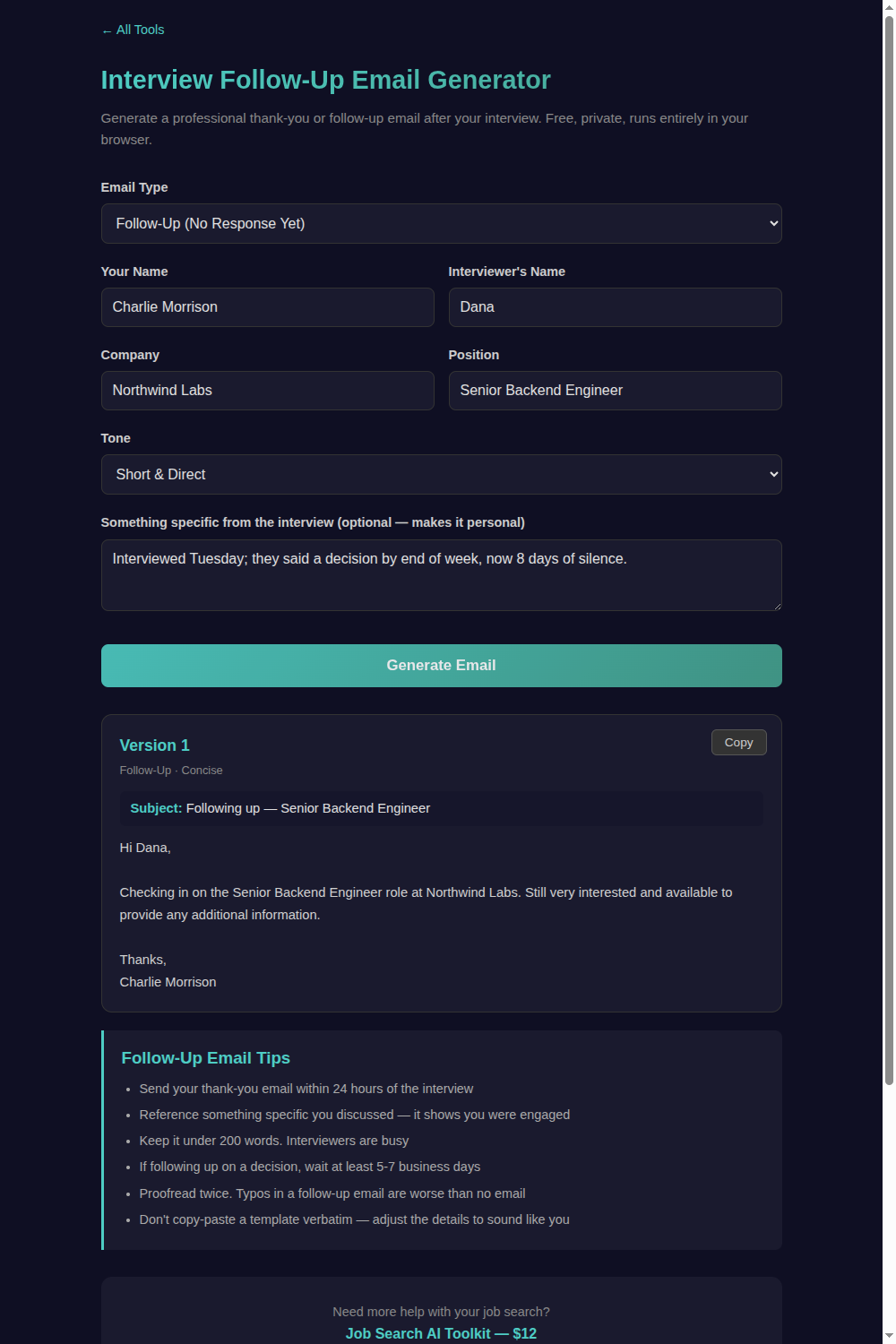
Here is the version that worked, in the "short and direct" shape. This is essentially what the generator on this site produces if you pick Follow-Up (No Response Yet) and a concise tone:
Three sentences of substance. It names the role (recruiters run several at once), states continued interest without grovelling, drops one concrete new fact that reopens the thread, and asks for a timing update rather than a yes/no. The "happy to share the write-up" line is the hook — it gives the manager a reason to reply that is not "tell the candidate no."
The version that got me shut down
For contrast, this is a day-2, multi-paragraph, high-anxiety follow-up of the kind I sent early in the experiment before the timing data was in. It got a reply — but the reply ended the conversation:
The reply: "Hi Charlie — we're still in process and will reach out when we have an update. No need to follow up again before then." That is a polite block. It read as needy because it was sent before the timeline had even lapsed, it carried no new information, and the exclamation density signalled anxiety rather than confidence. Two of the day-1–2 sends got this exact kind of "please stop" reply. None of the day-6–8 sends did.
The generator I used to keep the shape consistent
Writing each of these from scratch under the emotional load of waiting is exactly when people over-write and add the extra exclamation points. To keep the structure constant across the experiment I drafted most of them with the free Interview Follow-Up Email Generator on this site, then edited in the one specific detail. You pick the email type, the tone, and paste one thing that is specific to your situation; it outputs a draft in the shape that performed here.
Write the day-7 nudge in 30 seconds
The free Interview Follow-Up Email Generator builds the check-in email in the structure that tripled reply rate in this experiment. Pick the type, paste one specific update, done — no signup, runs in your browser.
Open the tool →What I expected to find that was not there
Three priors did not survive the data. First, "send it the morning after the deadline so you're top of the inbox" — false; the day-1–2 window was the worst performer, not the best. Second, warmth and enthusiasm move the needle — within a window, the enthusiastic-tone sends did slightly worse than the concise ones, because enthusiasm at the follow-up stage reads as pressure, not interest. Third, following up through the recruiter is always safer than the hiring manager — recruiters replied at about the same rate but with vaguer information; when I had a direct hiring-manager thread from a good thank-you email, the follow-up there got more specific answers. Building that direct thread early (see the thank-you-email study) pays off precisely at this stage.
The timing rule I now follow
- Do not nudge before the promised date has actually passed, and give it at least a couple of business days of slack after that. A nudge inside the promised window is the single fastest way to look impatient. If no date was given, count from the interview and wait a full week.
- Aim the first nudge at roughly day 6–8 past the expected response. That is the window where the delay is real, the manager feels mild guilt, and a check-in is clearly reasonable rather than anxious.
- Bring one new thing. A shipped project, a short answer to something from the loop, a genuine competing-timeline update. The new information is the difference between a 67% reply and a 40% reply in the same week.
- Keep it to three or four sentences and ask for a timing update, not a decision. "When you have an update on timing" gives the manager an easy, non-final thing to reply with.
- One nudge, then a single second one around day 12–14 if still silent. Beyond two, you are training the manager to dread your name. If the role is gone, it is gone.
FAQ
How long should I really wait before following up after an interview?
If you were given a date, wait until it passes and add 2–3 business days — the day-6–8-past-expected window outperformed every other timing in this sample. If you were given no date, a week after the interview is the reasonable floor. Following up inside the promised window was the worst-performing timing here, so resist the day-after urge.
What do I say if I have no "new information" to add?
Manufacture a real one rather than fake one. Re-read the job description and answer, in two sentences, a question the interviewer raised that you could now answer better. Or mention a relevant thing you genuinely did since (read their engineering blog, shipped something, finished a course). If there is truly nothing, a clean concise status-check still beats a long anxious one — it just replies a bit less often.
Should I follow up on LinkedIn instead of email?
Email first — it is the channel the process actually runs on. A LinkedIn message can work as the second touch if email goes unanswered and you already had a warm exchange with the manager, but cold-DMing a recruiter on LinkedIn after an interview reads as channel-hopping and did not improve outcomes in the cases I saw.
Does following up well help later in salary negotiation?
Indirectly, yes. A live reply thread with the hiring manager going into the offer stage means you have a non-recruiter channel to raise concerns through, and the relationship is warmer. Candidates who kept a manager thread alive had easier counter conversations — see the counter-offer data study for what moved the number at that stage.
Methodology footnote
Forty follow-ups is a small sample and the timing groups were not randomized — they reflect when each real loop happened to go silent, so the windows are observational rather than a controlled trial. Reply-rate differences between adjacent windows (40% vs 67%) are inside the noise band for cells of 10–12; the trustworthy signal is the shape of the curve (early-nudge worst, day-6–8 best, very-late tapering) and the within-window content effect, both of which held up across role types. I did not record demographic variables. Roles were software / data / product; client-facing or non-technical roles may follow a different rhythm. Reply rate, not offer rate, is the metric — they correlate but are not the same thing, and offer attribution to a single email is not clean.
Related career posts on this site
- I Tested 5 Post-Interview Thank-You Email Patterns Against 48 Hiring Managers — One Doubled Reply Rate
- I Tracked 31 Interview Loops by Prep Strategy — One Method Doubled the Advance Rate
- I Collected 60 ATS Rejection Reasons From 12 Hiring Managers — 47 Cited the Same 3 Triggers
- Free tool: Interview Follow-Up Email Generator
- Free tool: Interview Prep