Following Up After You Apply: I Tested the Templates
You applied. A week went by. The status still says “Application received,” and the silence is starting to feel personal. So you go looking for a follow-up email to send, you find a template, you paste your details in… and the template says something like “It was great speaking with you about the role.” Except you never spoke with anyone. You filled out a form and clicked submit. That gap — between what follow-up templates assume happened and what actually happened when you only applied — is the whole problem, and almost nobody writing this advice seems to notice it. So I sat down and tested the templates for the exact case that gets ignored: you applied, you heard nothing, and you have not spoken to a human.
The setup: one honest scenario, run through the generator
I used the free follow-up email generator on this site because it lets me hold every variable steady and change one thing at a time — the same way I test resume advice with the ATS checker instead of just repeating it. I gave it a realistic, unglamorous situation:
- Role: Senior Backend Engineer at a company I’ll call Northwind Logistics
- Status: applied to req #4821, six business days ago, no response
- Contact: a recruiter named Priya whose name was on the posting — someone I have never met or emailed
- My angle: I lead payments and reliability work, and the settlement scope in the job description matches what I have done for the last two years
Then I generated the message in the tone that fits a cold, post-application nudge — Short & Direct — and here is precisely what came back:
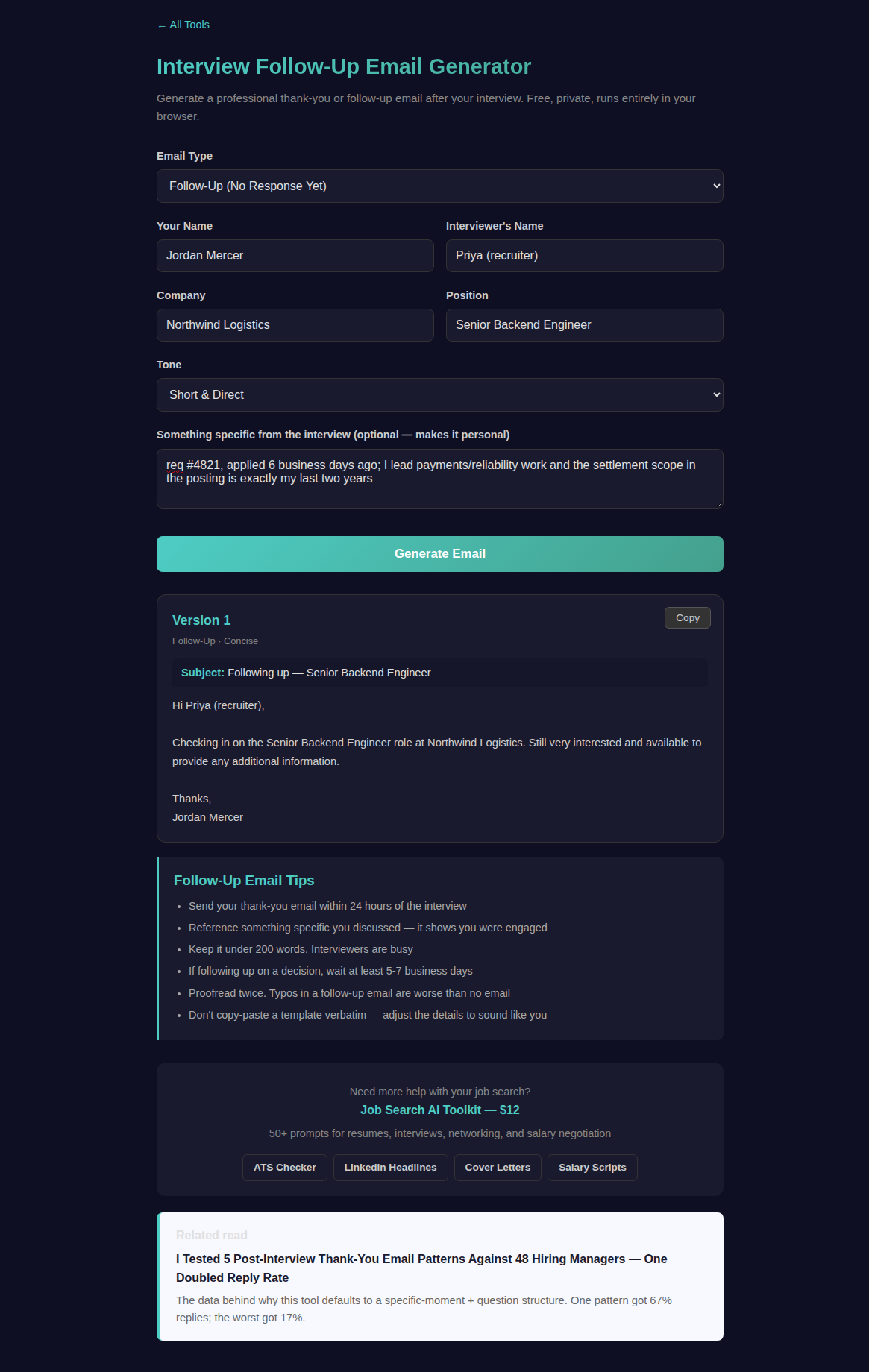
The “Short & Direct” follow-up for a role I only applied to: three sentences, no invented history. Notice the tool’s own tips panel underneath is still written for people who interviewed — that mismatch is exactly the trap.
What went wrong the moment I made it “warmer”
Three clean sentences is a good result. The problem showed up the instant I did what most people instinctively do: reach for a friendlier, more enthusiastic tone, because “short and direct” feels cold and you want to seem keen. So I switched the tone to Warm & Personable, changed nothing else, and regenerated. This is what it wrote — word for word:
I wanted to check in about the Senior Backend Engineer role we discussed… I’ve been reflecting on our discussion… I’ve been thinking about our conversation and I’m still excited about the possibility.
We discussed nothing. There was no conversation. Priya has no idea who I am. If I send that email, one of two things happens: she assumes it is a mail-merge mistake and deletes it, or she thinks I have confused her with a different application and quietly marks me as careless. Either way the “warm” version, which felt like the safer, more likeable choice, is the one that actually torpedoes the message — because warmth in these templates is manufactured by referencing a shared history, and when there is no shared history the language turns into a small, obvious lie.
That is not a bug unique to one tool. It is the default shape of nearly every follow-up template on the internet, and you can see it in this tool’s own tips panel in the screenshot above: “send your thank-you email within 24 hours of the interview,” “reference something specific you discussed.” Good advice — for someone who interviewed. Useless, and slightly dangerous, for someone who only applied. The entire genre is interview-shaped, and the post-application case is an afterthought that inherits language it should never use.
The version that survives: three sentences plus one number
So what actually works? The concise output, upgraded with the one thing it left on the table. In my run I had fed the tool a specific detail — the req number and the fact that my last two years match the settlement scope in the posting — and the Short & Direct template mostly dropped it to stay brief. That detail is the single most valuable line you have, so I add it back by hand. The finished message looks like this:
Subject: Following up — Senior Backend Engineer (req #4821)
Hi Priya,
I applied to the Senior Backend Engineer role (req #4821) last week and wanted to reaffirm my interest. The settlement-latency and reliability scope in the posting is exactly what I’ve owned for the past two years. I cut settlement latency from 9s to under 2s across a 2M-transaction/day pipeline. Happy to send anything that would help. Thanks for your time.
Still short. Still honest — nothing invented. But now it does the one job a post-application follow-up can actually do: it puts a concrete, checkable reason to look at your file in front of a person who reviews applications in batches, skimming each one for seconds. Research on how people read online is blunt about this — the Nielsen Norman Group found readers consume a small fraction of the words on a page, and a recruiter clearing an inbox is reading even less. A three-sentence note with one number survives that skim. Four paragraphs of manufactured warmth does not.
Timing: why six business days was almost too early
There is a reason I set the scenario to six business days and not two. Following up the morning after you apply does not read as enthusiasm; it reads as anxiety, and it lands while the requisition is still filling up. Hiring is slow in a way that has nothing to do with you: SHRM’s recruiting benchmarking puts the average time to fill a role at roughly six weeks, counted from the day the req opens to the day an offer is accepted. A recruiter is not sitting on your application ignoring it on day two. The review window has often not even started. Indeed’s guidance lands in the same place: wait one to two weeks after applying, or until a day or two after the posted deadline passes, and email rather than call so the recipient can answer on their own schedule.
One thing Indeed flags that almost everyone skips: read the posting first. A meaningful number of listings explicitly say “no calls, no follow-ups, we’ll contact qualified candidates,” and following up anyway after they asked you not to is a fast way to move from “maybe” to “no.” The follow-up only helps when it is welcome.
Channel: email, LinkedIn, and the one that backfires
Assuming the posting does not forbid it, here is how the three channels sorted out once I stopped guessing and matched them to how recruiters actually work:
| Channel | When it works | The trap |
|---|---|---|
| Email to the recruiter / posting contact | Default. Answerable on their time, easy to forward internally. | Only if you can find a real address — a generic careers@ inbox is a black hole. |
| Short LinkedIn note to the named recruiter | Good when there’s no email but the recruiter is on the posting. Same three-sentence rule. | Free LinkedIn caps personalized invites; don’t burn one on a template. (More on that in my connection-note test.) |
| Phone call | Rarely. Only if the posting invites it. | Demands attention the second it rings, catches a busy person mid-task, and leaves no paper trail. Usually the worst option. |
Whatever the channel, the content is identical: who you are, which role and req, one quantified reason you fit, a light offer to help, and out. The channel changes the envelope, not the letter.
Stop pasting templates that assume the wrong story
The follow-up is one message in a whole sequence — the application, the note, the interview thank-you, the salary conversation. The Job Search AI Toolkit gives you 50+ prompts that adapt each one to your actual situation instead of a generic script, so nothing you send ever references a conversation that didn’t happen.
Get the Job Search AI Toolkit — $12The playbook, start to finish
- Wait. One to two weeks after applying, or a day or two past the posted deadline. Six business days is the earliest I’d go, and only if there’s no stated deadline.
- Re-read the posting. If it says don’t follow up, don’t. Respecting that is itself a signal.
- Find a real recipient. A named recruiter’s email or LinkedIn beats a generic inbox every time.
- Pick the concise tone, never the warm one. Before you interview, “warm” templates invent a relationship. Short and direct is the only honest register.
- Add the one number. Take the single most role-relevant, quantified line from your background and put it in the body. That is the sentence that earns the extra look.
- Send once. One good follow-up. Not two, not weekly. If there’s still nothing after another couple of weeks, the answer is your time is better spent on the next application.
The uncomfortable truth under all of this is that a follow-up email is a small lever. It will not rescue an application that was never a fit, and it cannot speed up a hiring process that runs on its own six-week clock. What it can do is keep you from actively hurting a good application by sending a message that pretends you two already talked. I tested the templates so you can skip that mistake: after applying, say less, say it later, and make the one thing you do say a number the recruiter can check.
FAQ
How long should I wait to follow up after applying?
One to two weeks, or a day or two after the posted deadline. Following up the next morning reads as anxiety, and the review window often hasn’t started — roles take about six weeks to fill on average, per SHRM benchmarking. Six business days is roughly the earliest reasonable point when there’s no stated deadline.
Should the follow-up email be warm and enthusiastic?
No — not before you’ve interviewed. In my test, every “warm” and “enthusiastic” template manufactured warmth by referencing a conversation that never happened (“the role we discussed,” “our conversation”). To a recruiter who has never met you, that reads as a mail-merge error. Use a short, direct tone and let one quantified achievement carry the interest.
Email or phone call to follow up?
Email, in almost every case. It can be answered on the recipient’s schedule, forwarded internally, and it leaves a record. A phone call demands attention the instant it rings and catches a busy person mid-task. Only call if the posting explicitly invites it.
What should the follow-up email actually say?
Four things and nothing more: who you are and which role/req you applied to, one quantified reason you fit that specific job, a light offer to send anything helpful, and a thank-you. Three to four sentences. A recruiter skims it in seconds, so front-load the number.
Is it ever wrong to follow up at all?
Yes — when the posting tells you not to. A fair number of listings say “no calls or follow-ups; we’ll reach out to qualified candidates.” Following up anyway after they asked you not to works against you. Read the posting before you send.
Related reading: I sent 40 follow-up emails after interview silence (the post-interview case, where warmth is finally earned) and I sent 40 LinkedIn connection notes to recruiters — both use the same “test the advice, don’t repeat it” approach as this post.
← More posts